
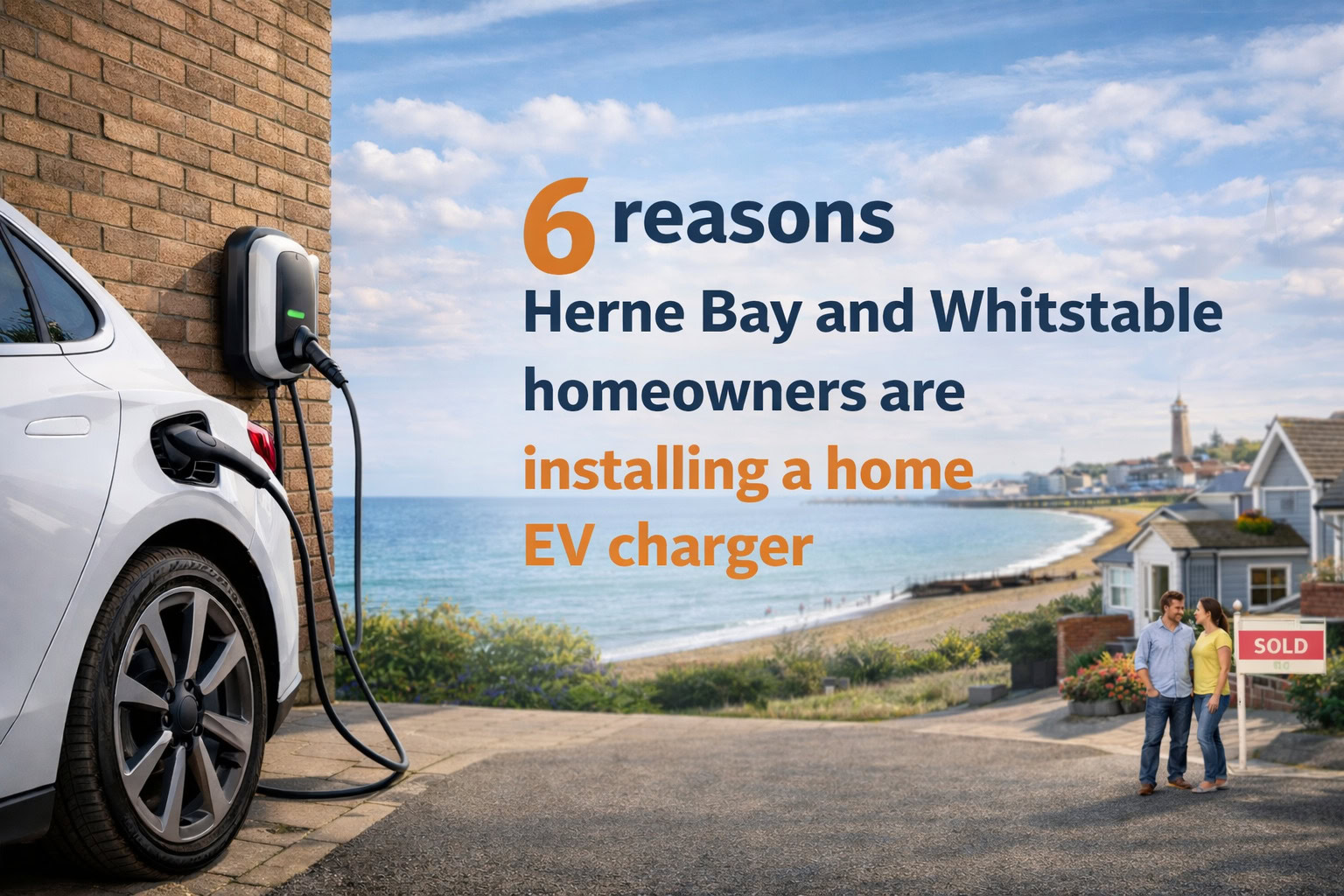
⚡ 6 reasons Herne Bay and Whitstable homeowners are installing a home EV charger
Electric cars are becoming far more common on UK roads — and that is starting to influence what homeowners prioritise when they improve their property. For many households in Herne Bay and Whitstable, a home EV charger is no longer a niche extra. It is a practical upgrade that can make day-to-day life easier now, while also helping a home feel more future-ready when the time comes to sell.
That does not mean every charger adds a fixed amount of value, and it certainly does not replace the basics like presentation, pricing and condition. But for the right property — especially one with a driveway or off-road parking — it can be a very useful feature that makes a home more attractive to modern buyers.
✅ 1) Faster, easier overnight charging at home
One of the biggest advantages is simple convenience. A dedicated home charger is dramatically quicker than relying on a standard three-pin plug, which can take well over a day to fully charge some vehicles. By contrast, a typical 7.4kW home charger can often fully charge an EV overnight.
For busy households in Herne Bay and Whitstable, that means you can plug in in the evening and wake up ready to go — whether that is for commuting, school runs, shopping or a longer coastal journey at the weekend.
💷 2) Home charging can be much cheaper than public charging
Cost is another major reason homeowners install one. Charging at home can be significantly cheaper than relying on public chargers, especially if you use an EV tariff or off-peak electricity overnight.
That matters because although the public charging network is growing, regular public charging can still be the more expensive option. A home charger gives owners more control over when they charge and what they pay.
- Typical home charge example: around £8 for a 50kWh battery on an EV or time-of-use tariff
- Extra saving potential: smart overnight charging can cut charging costs further
- Practical benefit: better control over running costs from home
🏡 3) It can make a home more appealing to future buyers
Not every buyer will care about EV charging today — but more will tomorrow. Battery electric cars made up 24.2% of new UK car registrations in February 2026, with a 22.0% year-to-date share. That is a sizeable part of the market already, and it helps explain why more buyers now notice whether a home is EV-ready.
In practical terms, a charger is best thought of as a marketability feature rather than a guaranteed price booster. It can help your property stand out, strengthen first impressions online, and reduce the “jobs list” for buyers who already own an EV or expect to in the near future.
🚗 4) It is especially useful in Herne Bay and Whitstable if you have off-road parking
This is where the local angle really matters. Kent County Council is working to expand on-street charging across the county, but public provision is still catching up and cross-pavement charging solutions are not yet fully settled on Kent highways.
That means homeowners with a driveway, parking bay or other off-road space have a genuine advantage: they can install their own charger and avoid depending entirely on public infrastructure.
In parts of Whitstable in particular, off-street parking is more limited, and Canterbury City Council’s own EV strategy highlighted that home charging is expected to remain the preferred and most economical option for many drivers. So, where a property does have private parking, an installed charger can be a stronger selling point than many owners realise.
📍 5) It helps reduce reliance on the public network
The UK’s public EV charging network is continuing to grow quickly, with 116,052 public EV chargers recorded as of 1 January 2026. In the South East, there were 149.4 chargers per 100,000 residents. Kent is also pushing ahead with more on-street chargers and more public charging in council car parks.
That is encouraging — but for many homeowners, the real attraction of a home charger is not having to think about availability, waiting time or charging away from home unless they actually need to. In other words, public charging is useful back-up; home charging is what makes EV ownership feel easy.
🌞 6) Smart chargers can work better with off-peak tariffs and solar
Modern chargers are not just sockets on the wall. Many are “smart” devices that let owners schedule charging for cheaper overnight periods, monitor usage through an app, and in some cases integrate with solar generation.
For homeowners already thinking about wider energy efficiency improvements, that makes an EV charger part of a bigger picture: smarter energy use, more control over bills, and a home that feels better aligned with where buyer expectations are heading.
📍 What this means for Herne Bay and Whitstable homeowners
If you already own an EV and have private parking, a home charger is usually a very logical upgrade. It improves convenience immediately and may also help your home feel more current and better equipped when buyers compare it against similar properties.
If you are thinking about selling, the key is to present it properly. Do not overclaim and do not assume buyers will pay a huge premium purely because a charger is installed. But if the charger is professionally fitted, sensibly positioned and easy to use, it is absolutely the sort of feature worth highlighting in your marketing.
If your property does not have off-road parking, the conversation is slightly different. Public and on-street charging provision is improving across Kent, but practicality still varies street by street. In that case, it is better to be accurate and realistic rather than trying to sell the home as “EV-ready” if the day-to-day setup is not straightforward.