Posted on

6 summer property features that can help your home stand out

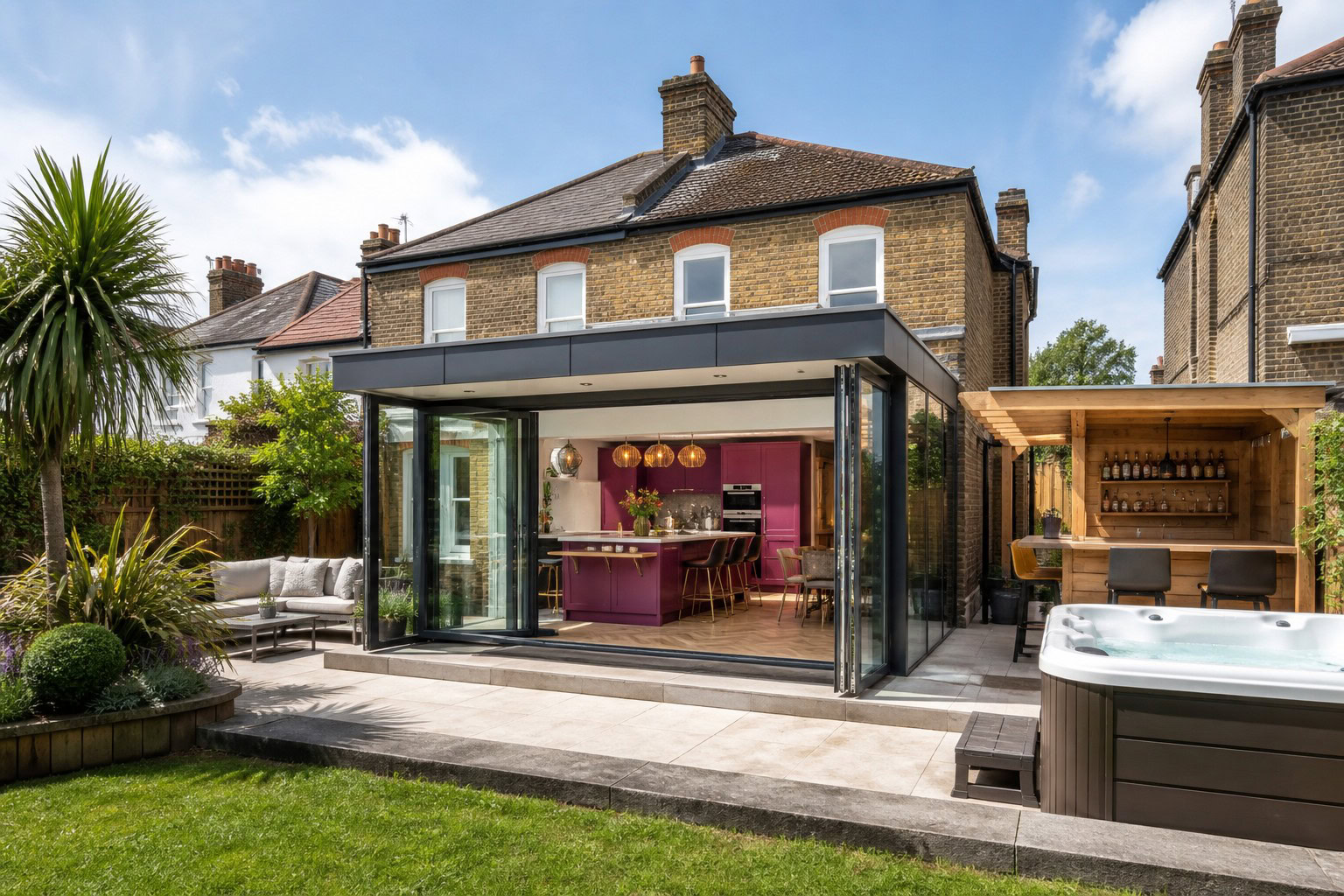
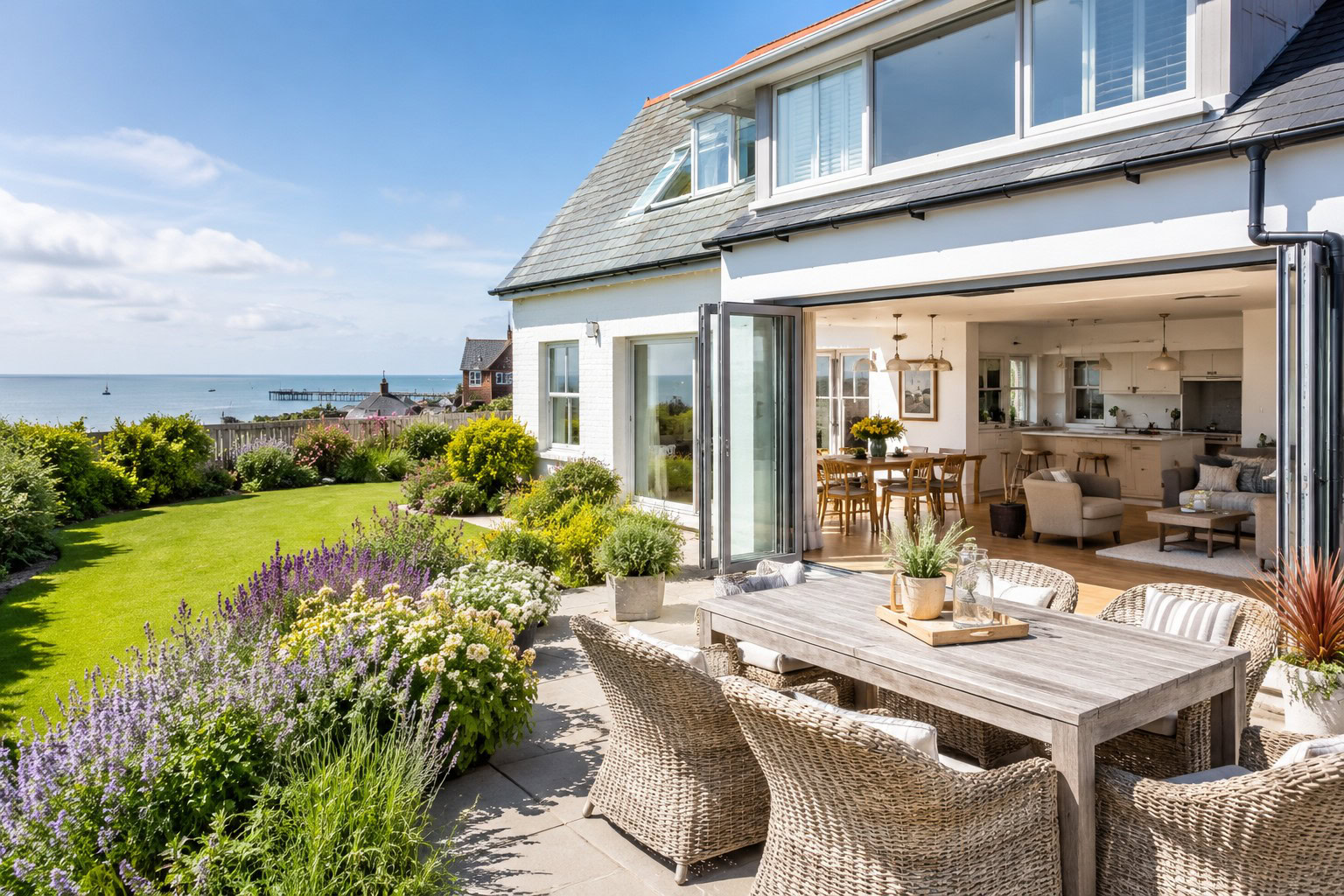
Sunny coastal home with bifold doors, landscaped garden and outdoor seating, highlighting summer property features that can add value in Herne Bay and Whitstable

☀️ 6 summer property features that can help your home stand out

When the sun is shining, buyers often start looking at homes differently. Gardens, balconies, outdoor seating areas and bright living spaces can suddenly feel much more important — especially for people imagining summer evenings, family barbecues or weekends by the coast.

According to Zoopla, seasonal features can influence how buyers feel about a property, with outdoor and lifestyle-led features becoming particularly attractive during the summer months. While not every home will have a swimming pool or hot tub, many properties have features that can be shown off more effectively at this time of year.

For sellers in Herne Bay, Whitstable and the surrounding Kent area, summer can be a great opportunity to highlight what makes your home special. Coastal living, sunny gardens, outside space and natural light can all help create an emotional connection with buyers.

🌿 1) A sunny garden or usable outside space

A garden can be a major selling point at any time of year, but it often has the strongest impact in spring and summer. Buyers are more likely to imagine themselves using the space when the lawn is green, plants are in bloom and the patio looks ready for a morning coffee or evening meal.

South-facing or particularly sunny gardens can be especially attractive because the orientation of a property cannot easily be changed. However, even a smaller garden, courtyard or terrace can make a strong impression if it is clean, tidy and clearly usable.

Before photographs are taken, it is worth cutting the grass, clearing weeds, washing patio areas, trimming hedges and putting away anything that makes the garden feel cluttered. A few simple touches, such as outdoor seating or potted plants, can help buyers understand how the space could be enjoyed.

🍽️ 2) Outdoor entertaining areas

Outdoor entertaining has become increasingly important to many buyers. A patio, decking area, pergola, barbecue space or sheltered seating area can make a home feel more lifestyle-focused, particularly during the summer months.

You do not need a large garden to create this effect. Even a modest seating area can help buyers picture themselves eating outside, hosting friends or relaxing after work. The key is to make the space feel intentional rather than forgotten.

If your home has bifold doors, French doors or direct access from the kitchen or living room to the garden, this is worth highlighting. Buyers often love the idea of indoor-outdoor living, especially when the layout makes entertaining feel easy.

🌊 3) Coastal lifestyle appeal

In areas such as Herne Bay and Whitstable, summer can really bring the local lifestyle to life. Proximity to the seafront, coastal walks, beach huts, cafés, independent shops and local restaurants can all become more appealing when buyers are viewing during warmer months.

This is particularly important for buyers moving into the area from elsewhere. They may not simply be buying a house — they may be buying into a lifestyle. If your property is close to the beach, town centre, station, harbour, schools or popular walking routes, those details should be made clear in the marketing.

Good property marketing should connect the home itself with the reasons people want to live locally. A well-presented coastal home can feel especially attractive when buyers can imagine summer weekends by the sea.

☀️ 4) Light, bright rooms

Natural light is one of the simplest but most powerful selling points. Bright rooms often feel larger, cleaner and more welcoming, especially in online photographs where first impressions matter.

Before viewings and photography, open curtains and blinds fully, clean windows, remove anything blocking natural light and consider using mirrors to make rooms feel brighter. Neutral decoration can also help reflect light and make the property feel more spacious.

If your home has a particularly bright kitchen, living room, conservatory, garden room or bedroom, this should be emphasised. Buyers often respond emotionally to homes that feel light and uplifting from the moment they walk in.

🪴 5) Balconies, terraces and small outdoor spaces

Not every property has a garden, but that does not mean outside space cannot be a selling point. Balconies, roof terraces, small patios and even well-presented communal gardens can all add appeal, particularly for flats and town centre homes.

In coastal towns, a balcony or terrace can feel especially valuable if it offers sea views, open outlooks or a pleasant place to sit outside. Even a compact balcony can make a property feel more special if it is clean, tidy and dressed well.

For sellers, the aim is to show buyers how the space can be used. A small table and chairs, a few plants or a simple seating area can make a balcony or terrace feel like an extra living space rather than an afterthought.

🏡 6) Flexible summer living spaces

Summer often changes the way people use their homes. Garden rooms, conservatories, home offices, summer houses and open-plan kitchen-diners can all become more attractive when buyers are thinking about family time, working from home or entertaining.

If your home has a room that connects well with the garden, this can be a strong feature. A conservatory, for example, may feel much more appealing when it is bright, clean and comfortably furnished. A garden office can also help buyers see the property as practical as well as attractive.

The important thing is to give each space a clear purpose. Buyers should not have to work too hard to understand how a room could be used. A well-presented flexible space can help your home appeal to a wider range of people.

📸 How to make the most of summer features when selling

Presentation matters. If your home has strong summer features, they should be prepared before the photographs are taken. Gardens should be tidy, outdoor furniture should be clean, rooms should feel bright and any lifestyle features should be shown clearly.

Timing can also help. If your property looks its best in the warmer months, launching while those features are at their strongest may help generate more interest. Buyers are often more emotionally engaged when they can see and feel the benefits straight away.

Good marketing should tell the full story. A property description should not simply list rooms and measurements. It should highlight the features that matter to buyers, including garden orientation, outdoor space, sea views, parking, local amenities, transport links and lifestyle benefits.

🏠 Thinking of selling this summer?

If you are thinking about selling in Herne Bay, Whitstable or the surrounding Kent area, it is worth getting honest local advice before going to market. The right strategy can help you understand which features are likely to appeal to buyers and how best to present your home.

A good estate agent will not just give you a valuation. They should advise on pricing, preparation, photography, marketing and how to position your home against similar properties currently available.

Summer can be a brilliant time to show a home at its best — but only if the launch is handled properly. With the right preparation and local guidance, your property can make the strongest possible impression from the start.

BOOK YOUR FREE SALES VALUATION

Source of inspiration: Zoopla’s article, “6 hot property features that add value in summer”. Read the original article here .

← Back to all property news & advice

Posted on

Why some homes fail to sell — and what successful sellers do differently

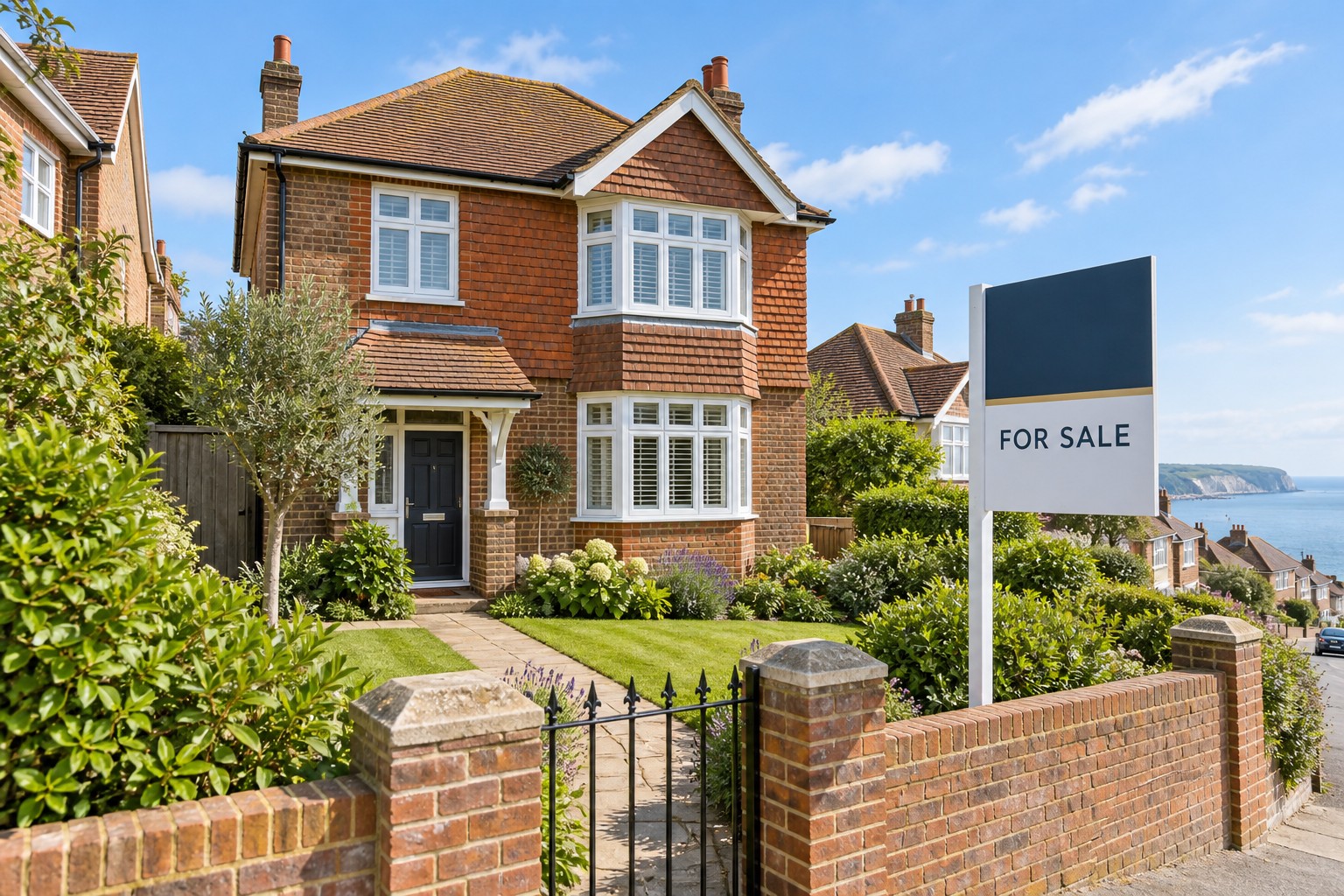
For sale sign outside a home with advice on why some homes fail to sell and how successful sellers price and present their property

🏡 Why some homes fail to sell — and what successful sellers do differently

Putting your home on the market is a big decision, so it can be frustrating when the interest does not turn into a successful sale. According to Zoopla, 44% of UK homes listed for sale in the past three years failed to sell, with overambitious pricing one of the main reasons properties became stuck on the market.

That does not mean sellers are powerless. In fact, many of the things that help a property sell are within your control from the very beginning — including the asking price, presentation, preparation and the quality of advice you receive before launching.

For sellers in Herne Bay, Whitstable and the surrounding Kent area, the message is clear: getting the price and strategy right from day one can make a significant difference. A strong launch can create momentum, attract serious buyers and reduce the risk of needing a later price reduction.

💷 1) Be realistic about the asking price

Zoopla’s research found that unrealistic pricing is one of the biggest reasons homes fail to sell. Some sellers know from the outset that their property is priced too high, while others only realise later that the figure was not in line with the market.

It is understandable to want the best possible price, especially if you are buying another property, downsizing, upsizing or managing rising moving costs. However, buyers are well informed. They can compare similar homes online, look at previous sold prices and quickly spot when a property appears too expensive.

In Herne Bay and the surrounding coastal market, pricing needs to reflect the property itself, not just the owner’s hopes. Sea views, parking, condition, garden size, lease length, proximity to the station, access to the seafront and local competition can all affect value. A realistic price is not about underselling — it is about positioning the property properly so buyers take it seriously.

📉 2) Do not rely on a later price reduction to fix everything

Zoopla reported that, for many sellers, reducing the asking price became the only way to attract a buyer. While price reductions can work, they are rarely as powerful as getting the launch price right in the first place.

The first few weeks of marketing are often when a property receives the most attention. Buyers who have alerts set up on property portals are quick to spot new listings. If the price feels too ambitious at launch, some buyers may dismiss it and never come back, even after a later reduction.

A sensible pricing strategy from day one can help generate viewings, encourage competition and avoid the property becoming stale online. It can also reduce the stress of sitting on the market for months without meaningful progress.

🏠 3) Get your valuation before falling in love with your next home

One of the most common mistakes sellers make is looking for their next home before getting a clear idea of what their current property is likely to achieve. Zoopla found that many sellers viewed properties before getting their own home valued, and some even made offers before understanding their selling position.

This can create pressure to price your home based on what you need, rather than what the market will support. Unfortunately, buyers do not base their offers on your onward purchase. They base them on value, condition, location and available alternatives.

Before making firm plans, it is sensible to arrange a proper local valuation. This gives you a clearer idea of your budget, your likely timescale and whether your move is realistic. It also helps avoid disappointment later in the process.

🧹 4) Presentation still matters

Price is important, but it is not the only factor. Zoopla highlighted that successful sellers often paid attention to appearance before going to market. Clean, tidy and well-maintained homes tend to make a stronger impression both online and in person.

That does not mean every seller needs to spend heavily on renovations. Often, small improvements can make a noticeable difference. Decluttering, tidying the garden, touching up paintwork, fixing minor defects and making rooms feel light and welcoming can all help buyers imagine themselves living there.

In a competitive market, buyers may compare your home with several others in the same price range. Good presentation can help your property stand out and can make viewings feel more positive from the start.

📸 5) Make sure your online listing works hard

Most buyers will see your property online before they ever book a viewing. That means your photographs, floorplan, description and key details need to work together to create interest quickly.

A good listing should highlight the home’s strongest features honestly and clearly. It should also make practical information easy to understand, including tenure, parking, garden space, location benefits and any important material information that may affect a buyer’s decision.

For local sellers, lifestyle details can be very important. Buyers moving to Herne Bay, Whitstable or nearby villages may be interested in the coast, schools, transport links, independent shops, countryside access and the character of the area. The right marketing should connect the property with the reasons people want to live there.

📍 6) Understand your local market

National property headlines can be useful, but they do not always reflect what is happening street by street. The market can vary significantly between towns, postcodes and even neighbouring roads.

A bungalow close to the seafront may attract a different buyer profile from a family house near schools, a flat close to the station or a period home in a village setting. Each property needs its own strategy based on likely buyers, competing homes and current demand.

This is where local knowledge really matters. A good estate agent should be able to explain not just what your property may be worth, but why — using comparable evidence, buyer feedback and current market conditions.

🤝 7) Listen to honest advice, not just the highest valuation

It can be tempting to choose the agent who gives the highest suggested asking price. However, the highest valuation is not always the best advice. If a price is set too high simply to win the instruction, the seller may lose valuable time and momentum.

A professional agent should give clear, evidence-based guidance. That may include a recommended asking price, a possible sale range, a marketing strategy and advice on what could be improved before launch.

The right agent should also review progress once the property is live. If viewings are low, feedback is weak or similar homes are selling faster, the strategy should be discussed rather than ignored.

🏠 What successful sellers tend to do differently

Successful sellers usually prepare early, price realistically and take local advice seriously. They understand that the asking price needs to reflect the market, not just their onward plans. They also make sure the property looks its best before the photographs are taken.

They also respond to feedback. If buyers are viewing but not offering, there may be an issue with presentation, price, layout expectations or competition. If buyers are not viewing at all, the marketing strategy may need attention.

For sellers in Herne Bay, Whitstable and the wider Kent area, the most important takeaway is that selling successfully is rarely about luck alone. It is about preparation, pricing, presentation and choosing an agent who understands the local market.

A good launch gives your home the best chance of success. If you are thinking of selling, getting an honest valuation before making firm plans can help you move forward with confidence.

BOOK YOUR FREE SALES VALUATION

Source of inspiration: Zoopla’s article, “Why half of UK homes fail to sell – and what successful sellers do differently”. Read the original article here .

← Back to all property news & advice

Posted on

5 things you should not expect from your estate agent

Estate agent speaking with clients beside a five-point guide explaining what sellers should not expect from their estate agent in Herne Bay, Whitstable and Kent.

🏡 5 things you should not expect from your estate agent

A good estate agent can make a huge difference when you are selling your home — but it is also important to understand what an agent can and cannot control. Selling a property involves buyers, sellers, solicitors, lenders, surveyors and sometimes several other homes in a chain, so not every delay or complication sits in the agent’s hands.

That does not mean your agent should simply list the property and disappear. A proactive estate agent should advise you properly, communicate clearly, chase progress, manage expectations and help keep the sale together. But there are some parts of the process where even the best agent has influence rather than direct control.

For sellers in Herne Bay, Whitstable and the surrounding Kent area, understanding this early can make the moving process less stressful. It also helps you judge your agent fairly — not just by whether problems arise, but by how well they deal with them.

⚖️ 1) They cannot make solicitors move faster

Estate agents spend a great deal of time chasing solicitors, checking where matters have reached and passing messages between the different parties. However, they cannot force legal work to be completed more quickly.

Searches, enquiries, mortgage conditions, leasehold packs and title issues all sit within the legal process. A good agent can keep pressure on, spot delays early and make sure everyone knows what is outstanding, but they cannot jump a file to the front of a solicitor’s queue.

The best way to reduce delays is to prepare early. Sellers can help by instructing a solicitor promptly, completing paperwork quickly and gathering key documents before a buyer is found.

📅 2) They cannot guarantee a completion date before exchange

It is natural to want certainty once an offer has been accepted, especially if you are planning removals, schools, work commitments or an onward purchase. But until contracts are exchanged, the completion date is not legally fixed.

Your estate agent can help coordinate dates, speak to solicitors, update the chain and flag any concerns. What they cannot do is guarantee that every buyer, seller, lender and solicitor involved will be ready on a particular day.

This is especially important in chains. One delay further up or down the chain can affect everyone. A good agent will not promise certainty too early, but they should keep you properly informed as the likely timescale becomes clearer.

📈 3) They cannot make an unrealistic asking price work

An estate agent should give honest, evidence-based advice on price. That advice should take into account the property itself, recent comparable sales, current competition, buyer demand and local market conditions.

However, buyers ultimately decide what they are prepared to pay. If a property is priced too far ahead of the market, it can lose early momentum, attract fewer viewings and sometimes need a later price reduction to regain interest.

For homes in Herne Bay and the surrounding villages, small differences can matter. Sea views, parking, condition, school catchments, garden size, lease length and proximity to the station or seafront can all affect value. A realistic launch price is usually far stronger than an ambitious figure that the market does not support.

🤝 4) They cannot stop buyers or sellers changing their minds

Property transactions can be emotional. Buyers may become nervous after a survey, mortgage circumstances can change, sellers may have second thoughts, or an onward purchase may fall through.

An estate agent’s role is to reduce that risk by keeping communication open, managing concerns quickly and helping both sides stay focused on the agreed outcome. But before exchange of contracts, either party can usually withdraw from the transaction.

That does not mean the agent has failed. Often, the work you do not see is the work that keeps a sale alive — calming nerves, clarifying misunderstandings, chasing missing information and keeping everyone engaged.

🧾 5) They cannot ignore legal, financial or material information

A good estate agent is there to help the sale progress, but they must also act properly. They cannot hide important information, invent interest, misrepresent offers, ignore material facts or pressure buyers into using particular services.

Agents must treat buyers and sellers fairly, keep clear records, pass offers on correctly and ensure property information is accurate and not misleading. That includes matters such as tenure, lease details, service charges, restrictions, known defects and other information that may affect a buyer’s decision.

This is why a professional agent may ask detailed questions before marketing starts. It is not box-ticking for the sake of it — it helps avoid problems later and gives buyers greater confidence from the outset.

🏠 What a good estate agent should do

While there are limits to what an estate agent can control, there is still a great deal they should be doing on your behalf. They should give realistic pricing advice, present the property well, arrange and follow up viewings, negotiate properly, record offers, check buyer position and help manage the sale through to completion.

They should also communicate clearly, especially when things become difficult. Silence is one of the biggest frustrations for sellers, so regular updates and honest advice are essential.

For sellers in Herne Bay, Whitstable and the wider Kent area, choosing the right agent is not just about who suggests the highest asking price. It is about who gives the clearest advice, understands the local market and has the experience to manage the sale once a buyer has been found.

The main takeaway is simple: your estate agent cannot control every part of the moving process, but they should take ownership of the parts they can influence. That is where good communication, local knowledge and careful sales progression really matter.

BOOK YOUR FREE SALES VALUATION

Source of inspiration: Rightmove’s article, “5 things you shouldn’t expect from your estate agent”. Read the original article here .

← Back to all property news & advice

Posted on

Rent increase rules in England: what landlords can legally do in 2026

Illustration for a blog about rent increase rules in England in 2026, showing a house on coins, a rent increase form, market graph, calculator and tribunal gavel

🧾 Rent increase rules in England: what landlords can legally do in 2026

If you let out property in England, it is important to understand exactly how rent increases now work — because the rules changed from 1 May 2026. Landlords can still increase rent, but the process is more structured, there are clearer limits, and tenants have stronger rights to challenge increases they believe are above the market level.

That matters because getting a rent increase wrong can create avoidable disputes, delay the increase taking effect, or leave a landlord relying on a notice that is not valid. In practice, the safest approach is to understand the rules first, check the local market properly and communicate clearly with the tenant from the outset.

For landlords in Herne Bay, Whitstable and the wider Kent market, the key point is this: a rent increase still needs to be reasonable, evidence-based and handled correctly. It is no longer just a question of putting the rent up when a tenancy reaches a certain point.

📅 1) Rent can usually only be increased once a year

Under the current rules in England, landlords can only increase the rent once in any 12-month period, and not in the first year of a new tenancy. That creates a clearer framework for both landlords and tenants and is designed to stop repeated increases within a short period.

This is one of the biggest practical changes landlords need to keep in mind. If you own a rental property locally, you should think ahead about timing rather than assuming the rent can be reviewed whenever market conditions change.

📄 2) The increase must be done using the correct formal notice

For private rented homes in England, landlords must now use Form 4A to propose a new rent. The notice must give the tenant at least 2 months’ notice before the new rent can start. It is also sensible to keep clear evidence that the notice was served properly.

That means an informal text, phone call or casual email is not enough on its own if you are relying on the statutory process. Using the correct form and serving it properly is a basic but important part of getting the increase right.

📈 3) The proposed rent should reflect the market, not just preference

Landlords can still increase rent to the market rate, but the increase should be fair and realistic. In practice, that means the proposed figure should reflect what the property would reasonably achieve if it were newly advertised to let in the current market.

That means looking at comparable homes in the local area, considering condition, size, location and presentation, and avoiding figures that are difficult to justify. A sensible increase supported by local evidence is far more likely to stand up if questioned.

⚖️ 4) Tenants can challenge an increase they believe is too high

If a tenant believes the proposed increase is above the market rent, they can challenge it through the First-tier Tribunal. The challenge must be made before the date the new rent is due to start.

The tribunal’s role is to determine the market rent. Importantly, the current rules are designed so that a tenant should not end up paying more than the landlord originally proposed simply because they challenged it. The new rent applies from the date of the tribunal’s decision rather than being backdated, and in cases of undue hardship the increase can be deferred by up to a further 2 months.

🚫 5) Landlords cannot use rent increases as a backdoor way to force tenants out

The purpose of the updated system is to allow genuine market-based increases while giving tenants protection against excessive rises designed to push them out. In other words, a landlord can still review rent, but the increase must be defensible.

That is why evidence matters. If a proposed increase looks out of step with the local market, it is more likely to be challenged and more likely to create unnecessary friction between landlord and tenant.

🏠 6) Existing private tenancies in England changed from 1 May 2026

From 1 May 2026, most existing assured shorthold tenancies in England automatically became assured periodic tenancies. New private tenancies agreed on or after that date are also assured periodic tenancies, which means the new rent increase framework applies across the private rented sector in England.

For landlords, that means it is worth reviewing older habits and template documents. Processes that used to be common under older tenancy arrangements may no longer reflect the current position.

🧠 7) Good communication still matters just as much as the paperwork

Even where the law allows an increase, how it is handled can make a real difference. Explaining the reasoning, giving tenants enough context and using sensible comparable evidence can often reduce the risk of dispute.

That also fits with good agency practice. The Property Ombudsman’s Code for Residential Letting Agents requires agents to act fairly, communicate clearly in writing and keep proper records, which is particularly relevant when dealing with rent reviews and tenancy administration.

📍 What this means for landlords in Herne Bay and Whitstable

The main takeaway is that landlords in England can still raise rent, but it now needs to be done through the correct formal route, at the right time and at a level that reflects the market.

If you are letting in Herne Bay or Whitstable, it is wise to review comparable local properties carefully before serving notice. A coastal flat, family house or modern apartment may all sit in very different rental brackets, so local evidence matters more than broad assumptions.

If you want the smoothest outcome, check the tenancy position, confirm the timing, use Form 4A correctly, give at least 2 months’ notice and make sure the proposed rent is properly supported.

And if you are unsure before increasing the rent, take advice first. A well-handled increase is far more likely to be accepted than one that feels abrupt, unclear or unsupported.

BOOK YOUR FREE RENTAL VALUATION

← Back to all property news & advice

Posted on

Buyer checklist for Herne Bay and Whitstable

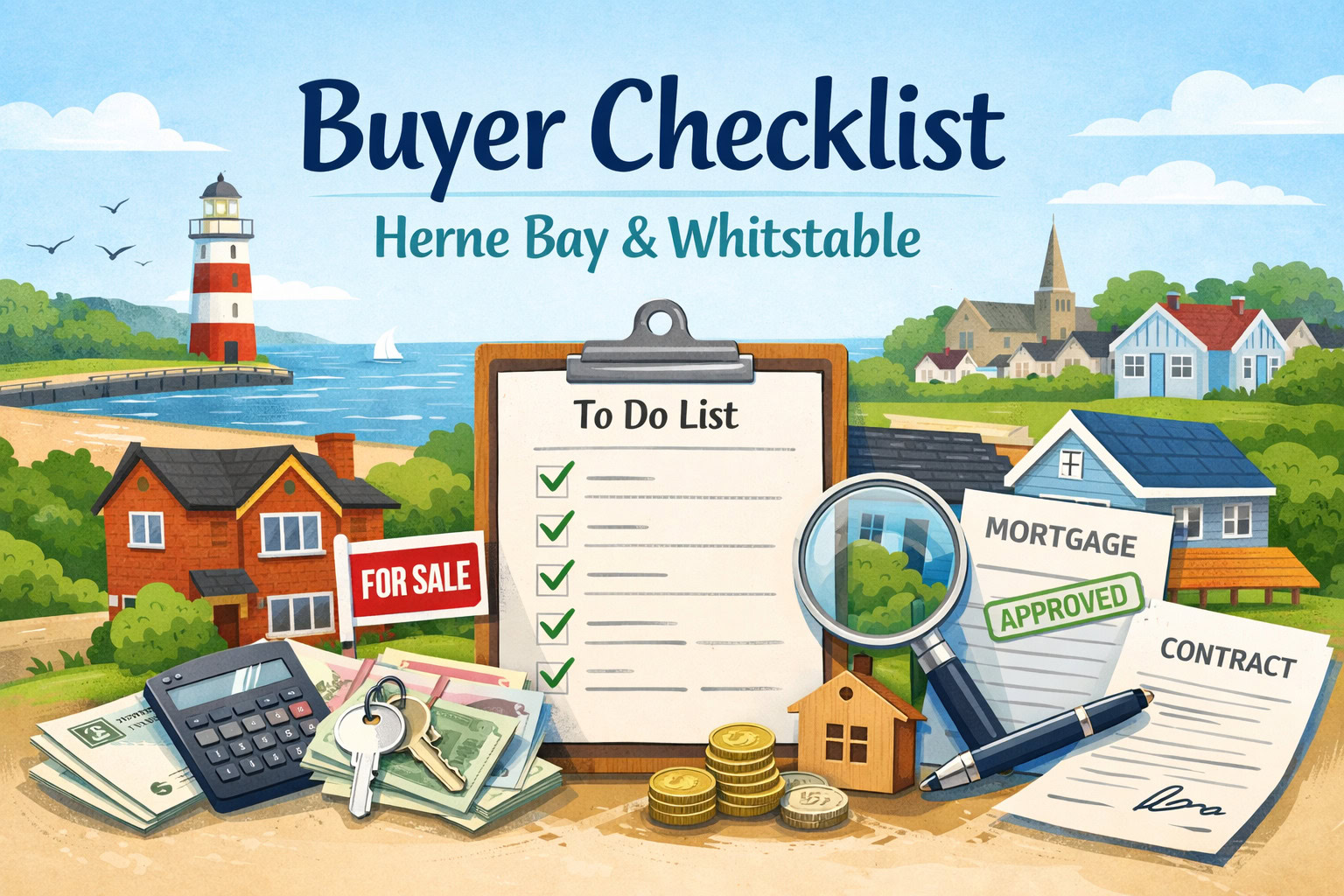
Buyer checklist illustration for home buyers in Herne Bay and Whitstable, showing houses, keys, paperwork and a coastal property scene.

🧾 Buyer checklist for Herne Bay and Whitstable

If you are planning to buy a home in Herne Bay or Whitstable, it helps to follow a clear checklist from day one — because the process is not just about finding a property you like. It also includes budgeting properly, arranging your mortgage, viewing carefully, making a sensible offer, progressing the legal work and getting ready for moving day.

That is exactly why having a step-by-step plan matters. Buyers who prepare early are usually in a stronger position when the right property comes up, and they are often better equipped to avoid delays later on.

For buyers in Herne Bay and Whitstable, the basics are the same as anywhere else — but local factors such as coastal homes, leasehold flats, parking, transport links and running costs can all affect the decision. A practical checklist makes it much easier to stay focused.

💰 1) Get clear on your budget before you start viewing

The first step is to make sure you are financially ready. That means checking your deposit, working out what you can comfortably afford each month, exploring mortgage options and understanding the extra costs that come with buying.

In Herne Bay and Whitstable, it is easy to focus on headline asking prices and forget the wider cost of ownership. Mortgage payments are only part of the picture. You also need to think about legal fees, survey costs, Stamp Duty where applicable, removals and the day-to-day running costs of the property.

Buyers who sort this out early tend to search more confidently and waste less time on homes that do not really fit their finances.

📍 2) Be specific about what you need from the area and the property

Once your budget is clear, the next stage is starting the search. Drawing up “would like” and “really need” lists is one of the best ways to stop your search becoming too broad.

For some buyers in Whitstable, being near the station or close to the town centre will be essential. For others in Herne Bay, outside space, parking or better value for money may matter more. Your ideal home usually sits somewhere between budget, location and space — not at the absolute maximum of all three.

It is also worth registering with local estate agents early. Good homes can attract quick attention, and buyers who are already in touch with agents often hear about suitable properties sooner.

🏡 3) View carefully and ask the questions that matter

When you start viewing homes, it is important not to focus only on décor or first impressions. You should also think about practical points such as parking, storage, running costs, local price trends, transport links, crime rates and the property’s EPC. It also makes sense to ask extra leasehold questions where relevant.

That is especially useful in Herne Bay and Whitstable, where buyers can be choosing between period homes, modern developments, converted flats and coastal properties. The right questions early on can save a great deal of stress later.

If a home is leasehold, make sure you understand who manages the building, what the service charges are, whether there are ground rent obligations and how the lease affects future costs and resale. That is not a small detail — it can materially change the attractiveness of a property.

✍️ 4) When you are ready, make your offer properly

Once you feel confident, the next step is choosing a solicitor, researching local sold prices and market trends, making your offer in writing and asking for the property to be taken off the market once the offer is accepted.

This is the point where preparation really starts to pay off. Sellers usually feel more confident dealing with buyers who already have their finances organised and can move forward without unnecessary delays.

In practical terms, buyers in Herne Bay and Whitstable should also think beyond the number itself. A slightly lower offer from a proceedable buyer can sometimes look stronger than a higher offer from someone who is not ready.

🏦 5) Arrange your mortgage as soon as the offer is accepted

After your offer is agreed, the mortgage stage becomes a priority. This usually means comparing rates, speaking to a broker or lenders directly, and being ready to show proof such as a mortgage agreement in principle.

This part can feel administrative, but it is central to keeping the purchase moving. Delays with documents, proof of income or lender requirements can hold everything up.

Where buyers have already done the groundwork before offering, this stage is often much smoother and less stressful.

🛠️ 6) Book a survey and take the findings seriously

It is also sensible to appoint a surveyor and arrange a survey to make sure everything is in order. If problems are uncovered, buyers may be able to renegotiate to reflect repair costs.

This matters in all areas, but particularly where homes are older, altered over time or exposed to coastal conditions. A survey does not automatically mean something is wrong — but it does help you make an informed decision.

If issues do come up, the key is to respond sensibly. Sometimes the result is a renegotiation. Sometimes it is simply a case of understanding the maintenance the property will need over time.

📑 7) Conveyancing is where momentum matters most

Your conveyancer will handle the transaction, manage searches, deal with ownership transfer, coordinate with others in the chain, arrange documents for signing and help move the matter towards exchange and completion. It is also important to stay on top of paperwork requests.

This is often the stage buyers find most frustrating because progress is not always visible day to day. But it is also where prompt responses can make a real difference.

If you are buying in Herne Bay or Whitstable, staying in close contact with your solicitor and agent can help prevent small issues from becoming longer delays.

🚚 8) Do not leave moving arrangements until the last minute

The final stage covers the practical moving-in checklist: booking removals, updating your address, arranging insurance, paying the relevant fees, packing carefully and making sure essentials stay with you on the day.

This sounds obvious, but it is often the part buyers underestimate. Once exchange and completion dates are in sight, things can move quickly.

Planning ahead makes the final stage feel much more manageable, especially if you are coordinating work, schools, family life or a related sale.

📍 What this means for Herne Bay and Whitstable buyers

The biggest mistake many buyers make is treating the purchase as just a property search. In reality, buying well means preparing your finances, asking the right questions, choosing the right professionals and staying organised all the way through.

If you are buying in Herne Bay or Whitstable, it pays to be especially thorough on location, running costs, parking, EPC performance and leasehold details where relevant. Those practical points often matter just as much as the property itself.

If you want the smoothest possible move, get mortgage-ready early, view with a checklist, make your offer clearly, appoint a proactive solicitor and stay on top of paperwork from the outset.

And if you are buying and selling at the same time, remember that strong preparation on your sale can make your onward purchase look much more attractive too.

BOOK YOUR FREE PROPERTY VALUATION

← Back to all property news & advice

Posted on

How long does it take to buy a home in Herne Bay and Whitstable?

House keys, paperwork, calculator and a small wooden house model showing the home buying process

⏳ How long does it take to buy a home in Herne Bay and Whitstable?

For most buyers, the purchase itself usually takes around 15 to 20 weeks once an offer is agreed — although some moves are much quicker and others can stretch closer to six months, particularly where there is a chain or legal complications.

That can feel frustrating when you have found the right property and just want to get moving. But in practice, buying a home is made up of several stages, each with its own pace. Some are within your control, while others depend on lenders, solicitors, surveyors, sellers and the wider chain.

For buyers in Herne Bay and Whitstable, the key is to understand where time is normally spent, what can slow things down, and what you can do early to keep the process as smooth as possible.

🔎 1) Finding the right property often takes the longest

The search stage can easily take three to 12 months, and in many cases it is the longest part of the whole journey. That is not necessarily a problem. It is usually better to view widely, compare properly and understand what matters most to you before you commit.

In Herne Bay and Whitstable, buyers often start with a broad brief and then refine it once they have viewed a few homes. Some realise they want to be closer to the station. Others decide parking matters more than they first thought. Some begin looking in Whitstable and then find better value in Herne Bay, or vice versa.

The more clearly you define your non-negotiables early on — budget, location, parking, outside space, condition and chain position — the easier it is to move quickly when the right property appears.

💷 2) Mortgage preparation is usually quicker than people expect

Securing a mortgage agreement in principle often takes only a few days to a couple of weeks, while the wider mortgage stage is commonly around two to four weeks. Buyers who do this before offering are usually in a much stronger position.

If you are serious about buying, it makes sense to get your finances lined up early. Sellers are far more reassured by a buyer who already knows their borrowing position, deposit amount and likely monthly costs.

In practical terms, that preparation can also help you make decisions faster. When a good property comes up in Herne Bay or Whitstable, hesitation can cost you, especially if interest is strong in the first few days.

✍️ 3) Making an offer is quick — agreeing the deal can still take a few days

Once you have found the right home, the offer stage itself is often fairly fast, with feedback commonly coming back within 24 to 48 hours. But agreeing final terms can still take several days if there is negotiation on price, fixtures, timing or chain position.

This is where being well prepared really helps. Sellers will usually look at more than just the headline number. They will also consider whether you are in a chain, whether your mortgage is ready, whether your own sale is under offer, and how flexible you can be on timescales.

It is also worth remembering that estate agents are required to pass on offers promptly and treat buyers fairly, so good communication at this point matters for everyone involved.

📑 4) Conveyancing is normally the slowest stage after the offer is accepted

The legal process is usually the biggest source of delay. A straightforward purchase might move in as little as six weeks, but a more typical conveyancing timeframe is six weeks to three months. Leasehold homes often take longer than freehold properties.

This is the stage where searches are ordered, contracts are reviewed, enquiries are raised and answered, and everyone tries to get comfortable with the legal side of the transaction. It is rarely dramatic from the outside, but there is often a great deal happening in the background.

Locally, this can be especially relevant for flats, maisonettes and some coastal apartments where leasehold information, management details and service charge paperwork can take longer to gather. Proper preparation at the start can make a real difference later on.

🛠️ 5) Surveys can be quick, but what they reveal may add time

The survey appointment itself can often be arranged within about a week, but the real question is what the report uncovers. If significant issues come to light, buyers and sellers may need to renegotiate, obtain quotes or agree works before moving forward.

That does not mean every survey causes a problem. Many simply confirm the sort of wear and tear you would expect in an older property. But where there are roofing concerns, damp, movement, timber issues or outdated services, the timeline can easily lengthen.

For period homes in Whitstable or older family houses in Herne Bay, this is often the stage where expectations need to stay realistic. A sensible response is usually better than a panicked one.

🔗 6) Chains are often what turn a straightforward purchase into a long one

Even when your own mortgage, solicitor and survey are all progressing well, a chain can slow everything down. Coordinating several linked sales and purchases is one of the biggest reasons transactions drift beyond the hoped-for timetable.

That is why first-time buyers are often attractive to sellers: they do not have a related sale to hold things up. But even then, the overall speed still depends on everyone else involved further up and down the chain.

Strong estate agency progression can help here. Regular updates, quick chasing and clear communication between all parties will not remove every obstacle, but they often prevent small delays from turning into major ones.

📍 What this means for Herne Bay and Whitstable buyers

If your purchase is taking around four to five months from offer agreed to moving day, that is usually not unusual. It can feel long when you are living through it, but in the current market that is still within a fairly normal range.

If things are dragging on, the first place to look is usually the legal stage. Outstanding enquiries, slow paperwork, leasehold information, survey follow-up and chain issues are all more common causes of delay than the initial offer itself.

If you want to improve your chances of a smoother move, get mortgage-ready early, instruct a proactive solicitor, return paperwork promptly, book your survey without delay and keep close contact with the agent handling the sale.

And if you are selling as well as buying, good preparation on the sale side matters just as much. Accurate information, clear communication and strong sales progression can make a noticeable difference to how quickly a buyer gets from agreed sale to completion.

BOOK YOUR FREE PROPERTY VALUATION

← Back to all property news & advice

Posted on

6 reasons Herne Bay and Whitstable homeowners are installing a home EV charger

Electric car charging at a home in Herne Bay and Whitstable, showing the benefits of installing a home EV charger

⚡ 6 reasons Herne Bay and Whitstable homeowners are installing a home EV charger

Electric cars are becoming far more common on UK roads — and that is starting to influence what homeowners prioritise when they improve their property. For many households in Herne Bay and Whitstable, a home EV charger is no longer a niche extra. It is a practical upgrade that can make day-to-day life easier now, while also helping a home feel more future-ready when the time comes to sell.

That does not mean every charger adds a fixed amount of value, and it certainly does not replace the basics like presentation, pricing and condition. But for the right property — especially one with a driveway or off-road parking — it can be a very useful feature that makes a home more attractive to modern buyers.

✅ 1) Faster, easier overnight charging at home

One of the biggest advantages is simple convenience. A dedicated home charger is dramatically quicker than relying on a standard three-pin plug, which can take well over a day to fully charge some vehicles. By contrast, a typical 7.4kW home charger can often fully charge an EV overnight.

For busy households in Herne Bay and Whitstable, that means you can plug in in the evening and wake up ready to go — whether that is for commuting, school runs, shopping or a longer coastal journey at the weekend.

💷 2) Home charging can be much cheaper than public charging

Cost is another major reason homeowners install one. Charging at home can be significantly cheaper than relying on public chargers, especially if you use an EV tariff or off-peak electricity overnight.

That matters because although the public charging network is growing, regular public charging can still be the more expensive option. A home charger gives owners more control over when they charge and what they pay.

  • Typical home charge example: around £8 for a 50kWh battery on an EV or time-of-use tariff
  • Extra saving potential: smart overnight charging can cut charging costs further
  • Practical benefit: better control over running costs from home

🏡 3) It can make a home more appealing to future buyers

Not every buyer will care about EV charging today — but more will tomorrow. Battery electric cars made up 24.2% of new UK car registrations in February 2026, with a 22.0% year-to-date share. That is a sizeable part of the market already, and it helps explain why more buyers now notice whether a home is EV-ready.

In practical terms, a charger is best thought of as a marketability feature rather than a guaranteed price booster. It can help your property stand out, strengthen first impressions online, and reduce the “jobs list” for buyers who already own an EV or expect to in the near future.

🚗 4) It is especially useful in Herne Bay and Whitstable if you have off-road parking

This is where the local angle really matters. Kent County Council is working to expand on-street charging across the county, but public provision is still catching up and cross-pavement charging solutions are not yet fully settled on Kent highways.

That means homeowners with a driveway, parking bay or other off-road space have a genuine advantage: they can install their own charger and avoid depending entirely on public infrastructure.

In parts of Whitstable in particular, off-street parking is more limited, and Canterbury City Council’s own EV strategy highlighted that home charging is expected to remain the preferred and most economical option for many drivers. So, where a property does have private parking, an installed charger can be a stronger selling point than many owners realise.

📍 5) It helps reduce reliance on the public network

The UK’s public EV charging network is continuing to grow quickly, with 116,052 public EV chargers recorded as of 1 January 2026. In the South East, there were 149.4 chargers per 100,000 residents. Kent is also pushing ahead with more on-street chargers and more public charging in council car parks.

That is encouraging — but for many homeowners, the real attraction of a home charger is not having to think about availability, waiting time or charging away from home unless they actually need to. In other words, public charging is useful back-up; home charging is what makes EV ownership feel easy.

🌞 6) Smart chargers can work better with off-peak tariffs and solar

Modern chargers are not just sockets on the wall. Many are “smart” devices that let owners schedule charging for cheaper overnight periods, monitor usage through an app, and in some cases integrate with solar generation.

For homeowners already thinking about wider energy efficiency improvements, that makes an EV charger part of a bigger picture: smarter energy use, more control over bills, and a home that feels better aligned with where buyer expectations are heading.

📍 What this means for Herne Bay and Whitstable homeowners

If you already own an EV and have private parking, a home charger is usually a very logical upgrade. It improves convenience immediately and may also help your home feel more current and better equipped when buyers compare it against similar properties.

If you are thinking about selling, the key is to present it properly. Do not overclaim and do not assume buyers will pay a huge premium purely because a charger is installed. But if the charger is professionally fitted, sensibly positioned and easy to use, it is absolutely the sort of feature worth highlighting in your marketing.

If your property does not have off-road parking, the conversation is slightly different. Public and on-street charging provision is improving across Kent, but practicality still varies street by street. In that case, it is better to be accurate and realistic rather than trying to sell the home as “EV-ready” if the day-to-day setup is not straightforward.

BOOK YOUR FREE PROPERTY VALUATION

← Back to all property news & advice

Posted on

Zoopla: UK House Prices Are Firming – What February 2026’s House Price Index Means for Buyers & Sellers in Herne Bay and Whitstable

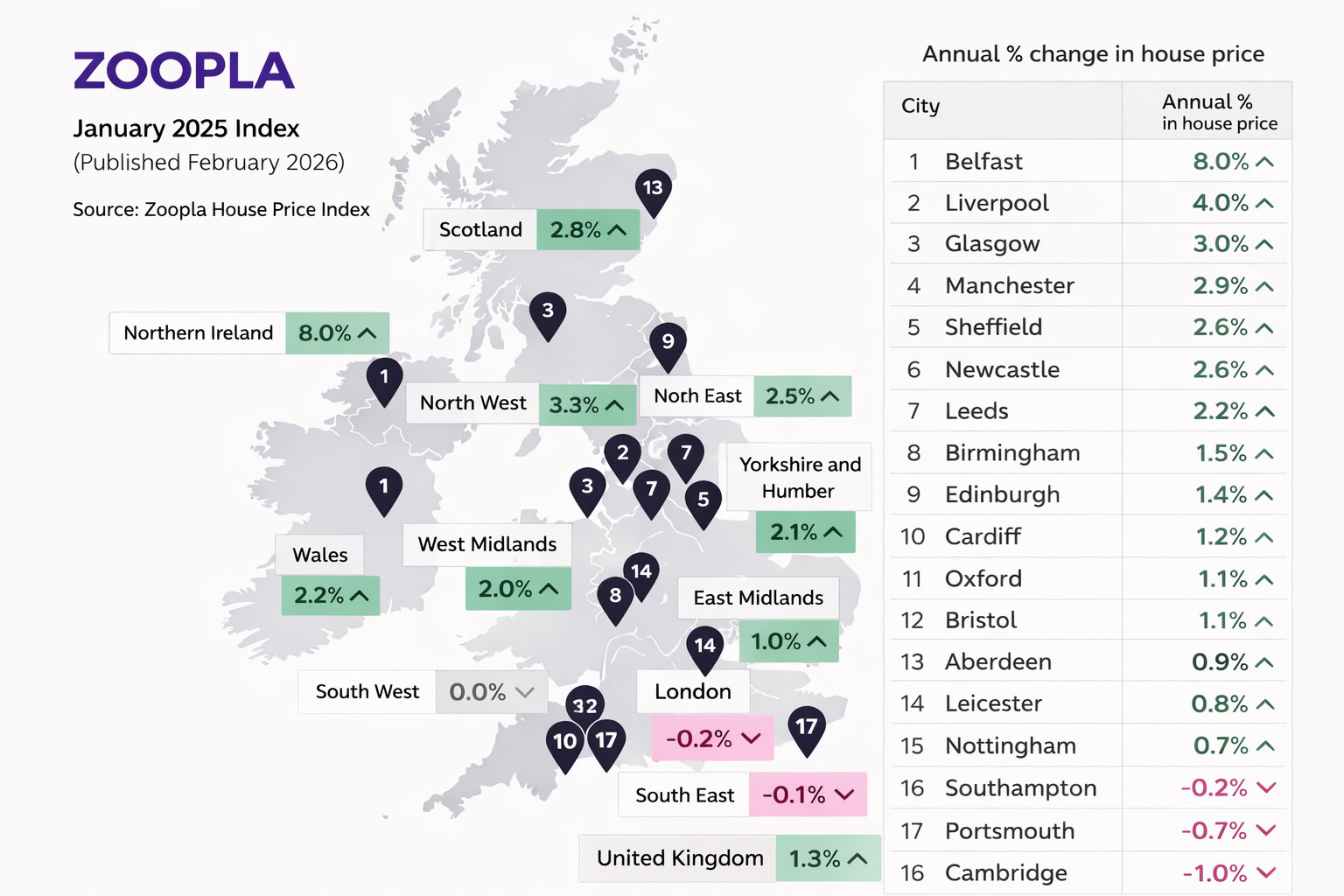
Zoopla House Price Index January 2025 infographic showing UK regional annual house price change and city rankings, published February 2026 (UK +1.3%, Northern Ireland +8.0%, Scotland +2.8%, North West +3.3%, North East +2.5%, Yorkshire and Humber +2.1%, Wales +2.2%, West Midlands +2.0%, East Midlands +1.0%, East of England +0.6%, South West 0.0%, London -0.2%, South East -0.1%; top cities include Belfast +8.0% and Liverpool +4.0%).

📊 Zoopla: UK House Prices Are Firming – What February 2026’s House Price Index Means for Buyers & Sellers in Herne Bay and Whitstable

The housing market has started 2026 with noticeably more momentum — but that doesn’t mean runaway price growth. Zoopla’s latest House Price Index (published 25 February 2026) shows sales activity strengthening as mortgage rates dip below 4%, while a big rise in the number of homes for sale is keeping price inflation modest.

✅ The Headline: Prices Up 1.3% – Activity Up, Inflation Still Subdued

Zoopla reports the average UK house price is £269,900, up 1.3% (£3,470) over the past year. That’s slightly lower than the annual growth rate recorded a year ago (Zoopla notes it was 1.8% a year earlier), which underlines the key point: the market is busier, but price growth remains restrained.

  • Average UK house price: £269,900
  • Annual house price change: +£3,470
  • Annual house price change (%): +1.3%
  • Zoopla’s view: “sales activity is healthy, but house price inflation remains subdued”

🏠 By Property Type: A Tale of Two Markets

The detail by property type is especially useful. Zoopla’s figures show houses continuing to rise, while flats/maisonettes are still down year-on-year. That matters locally, because coastal markets often have a higher proportion of flats and leasehold homes — and buyer expectations can change quickly when a segment is underperforming.

  • Flats/maisonettes: £191,500 (-1.3% / -£2,440)
  • Terraced houses: £240,100 (+1.9% / +£4,410)
  • Semi-detached houses: £278,800 (+2.7% / +£7,290)
  • Detached houses: £453,900 (+1.6% / +£7,320)

📈 Sales Are Strong – Even With Fewer Buyers

Zoopla says February 2026 has started with a strong rebound in activity, helped by the lowest mortgage rates in four years and improved access to mortgages (especially for first-time buyers).

What’s striking is that Zoopla reports agreed sales have increased sharply, even though there are 8% fewer buyers in the market compared with a year ago. They also note sales are still 3% below the very strong start to 2025 — but are running at the fourth strongest February level in the past decade.

  • Agreed sales: sharply increased (but 3% below early 2025 levels)
  • Buyer numbers: 8% fewer than a year ago
  • Seasonal context: fourth strongest February for sales activity in the last decade

🏷️ Big Story for 2026: A Surge in New Listings

For anyone selling in Herne Bay or Whitstable, this is the part to pay attention to. Zoopla highlights a surge in the number of sellers bringing homes to market, with February on track to be the highest monthly number of new listings in a decade.

Zoopla also says there are already 6% more homes for sale than a year ago, and that this is expected to rise further. More supply generally means buyers have more choice — and that tends to keep price growth in check unless demand accelerates faster than stock levels.

  • New listings: on track for the highest monthly level in a decade
  • Homes for sale: +6% vs a year ago (and expected to rise further)
  • Impact: increased choice for buyers, keeping price growth modest through 2026

💷 Mortgage Rates: Now Below 4% – But Don’t Expect Huge Further Falls

Zoopla says market activity is being supported by falling base rates and competition between lenders. The key takeaway is that average mortgage rates for new loans fell to their lowest level in four years in January, and both 2-year and 5-year fixed rates are now below 4% for the first time since 2022.

Zoopla’s caution: even if the base rate is cut again, mortgage rates may not fall much further — so the current window of improved affordability could be a meaningful driver of activity into spring and early summer.

🏡 Cheaper to Buy Than Rent: Now True for 40% of Homes

One of Zoopla’s most eye-catching findings is the shift in affordability testing. They explain that lenders are now typically assessing affordability using a 6.5% “stress rate” (down from 8.5% last year). Lower stress rates can increase borrowing capacity and improve “monthly maths” for buyers.

As a result, Zoopla estimates that 40% of homes for sale are now cheaper to buy with a mortgage than to rent locally (up from 25% a year ago, based on their methodology). They describe this as the strongest improvement in first-time buyer affordability since 2022.

  • Homes cheaper to buy than rent: 40% (up from 25% a year ago)
  • Affordability stress rate used: 6.5% (was 8.5% last year)
  • Zoopla’s assumptions: 1–3 bed homes under £600,000, 20% deposit, 30-year term, compared to rents in the same local authority

🗺️ Regions: Northern England & Scotland Stronger, Southern England Stabilising

Zoopla says annual house price growth is higher than a year ago in four areas: the North West, Scotland, the North East and Northern Ireland, helped by improved affordability and (in those areas) fewer homes for sale compared with last year.

In contrast, Zoopla notes that across southern England, house prices are broadly unchanged over the last 12 months. That’s an improvement on the more widespread falls seen in the second half of 2025, but affordability pressures and higher stamp duty costs are still weighing on demand in southern markets — especially alongside increased supply (Zoopla notes up to 16% more homes available in some areas).

📍 What This Means for Herne Bay & Whitstable

We sit firmly in the “southern England” dynamic Zoopla describes: improving mortgage conditions are helping activity, but buyers are generally more price-sensitive, and increased choice means they’ll compare homes ruthlessly.

If you’re selling: the biggest risk in a higher-supply market is overpricing at launch. In Herne Bay and Whitstable, we’re seeing buyers move quickly on well-presented, correctly priced homes — but they step back fast when a property feels out of line with comparable listings. Getting the pricing strategy right early can make the difference between strong early interest and a slow, price-chasing campaign.

If you’re buying: improved affordability (and the fact that more stock is coming to market) can create opportunity — but be ready. The best homes still attract competition, and being “proceedable” (AIP in place, solicitor lined up, clear onward plan) remains a real advantage when you negotiate.

BOOK YOUR FREE PROPERTY VALUATION

← Back to all property news & advice

Posted on

Mortgage Payments Are Easing – What January’s Figures Mean for Buyers & Sellers in Herne Bay and Whitstable

Infographic showing mortgage payments easing in January, with average monthly payment down and lower first-time buyer costs for Herne Bay and Whitstable buyers and sellers.

🏡 Mortgage Payments Are Easing – What January’s Figures Mean for Buyers & Sellers in Herne Bay and Whitstable

If you’ve been waiting for affordability to improve, the latest mortgage snapshot suggests things are moving in the right direction. New analysis published by Rightmove shows that the average monthly mortgage payment in January was lower than a year ago, helped by reduced mortgage rates and relatively modest house price growth.

📉 The Headline: Monthly Payments Down Year-on-Year

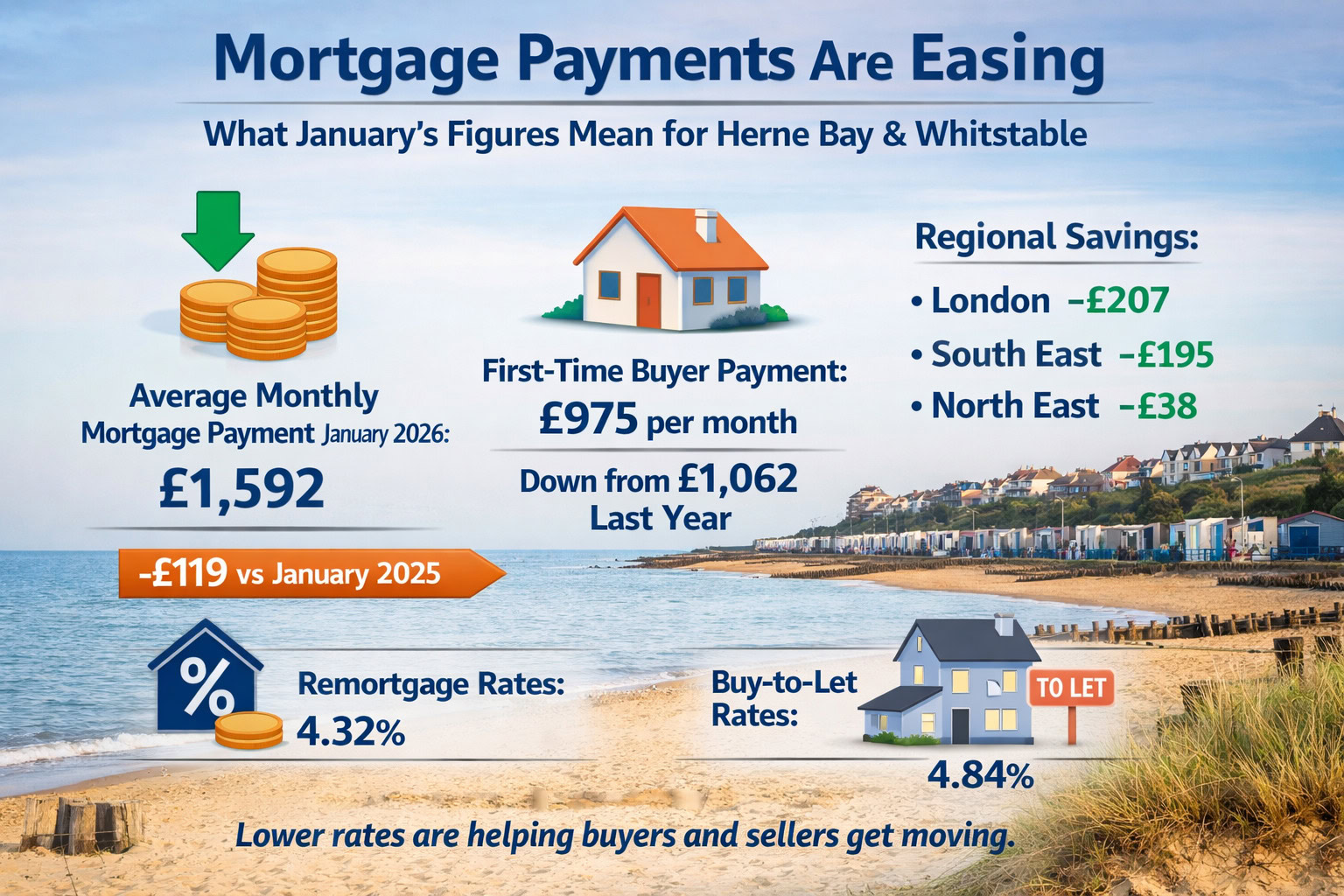
Rightmove reports that the national average monthly mortgage payment was £1,592 in January 2026 — which is £119 (7%) lower than January 2025, even though the average price of a home rose slightly over the year. This is largely down to cheaper borrowing costs compared with last winter.

  • Average monthly mortgage payment (Jan 2026): £1,592
  • Change vs Jan 2025: -£119 (-7%)
  • Average 2-year fixed rate (Jan 2026): 4.23% (down from 4.99% a year earlier)
  • Average asking price (Jan 2026): £368,031 (up 0.5% year-on-year)

📆 A Small Catch: January Was Slightly Higher Than December

While payments are down compared with last year, Rightmove also notes that the typical monthly payment in January was around £35 higher than in December 2025. The reason is simple: asking prices jumped month-on-month, so the loan size many buyers need has increased slightly.

In December 2025, the national average asking price was £358,138, which is notably lower than January’s figure.

👀 First-Time Buyers: A Meaningful Drop

For first-time buyers, the improvement is clearer. Rightmove puts the average first-time buyer home at £225,544 in January, with a typical monthly mortgage payment of £975 — down from £1,062 this time last year.

  • Typical first-time buyer payment (Jan 2026): £975/month
  • Typical first-time buyer payment (Jan 2025): £1,062/month
  • Illustrative 20% deposit on £225,544: £45,109

🗺️ Regional Snapshot: Where Savings Are Strongest

Rightmove highlights that the cash saving from lower rates varies by region — mainly because higher-priced areas feel rate reductions more strongly in pounds and pence.

For example:

  • London: biggest year-on-year reduction at -£207
  • South East: -£195 year-on-year (average monthly payment around £2,000)
  • North East: smallest year-on-year reduction at -£38

🏠 Remortgaging & Buy-to-Let: Rates Also Improved

If you’re refinancing, Rightmove says the average remortgage rate in January was 4.32% (down from 5.14% last year). For landlords, the average buy-to-let rate was 4.84% (down from 5.51% last year).

🗣️ What Rightmove’s Mortgage Expert Said

“We saw some headline-grabbing low mortgage rates… dropping to their lowest level since before the mini-Budget.”

— Matt Smith, Rightmove mortgage expert

📍 What This Means in Herne Bay & Whitstable

For our local market, improved affordability usually brings more viewings, more offers, and more proceedable buyers — particularly when first-time buyers feel the difference month to month.

If you’re selling in Herne Bay or Whitstable, this is the sort of shift that can help unlock demand — but pricing and presentation still matter. Buyers may have a little more headroom, but they’re still value-conscious and will compare your home against competing listings.

If you’re buying, the key is to get clear on what you can borrow now (and what rate you’d realistically secure), then move quickly when the right property appears — especially as spring activity builds.

BOOK YOUR FREE PROPERTY VALUATION

← Back to all property news & advice

Posted on

February & March: The Best Time to Get Your Home Sold

Coastal homes in Herne Bay and Whitstable during February and March, the best time of year to sell a property

🏡 February & March: The Best Time to Get Your Home Sold

If you’re thinking about selling your home in Herne Bay or Whitstable, timing could play a bigger role than you realise. New research from Rightmove shows that late winter and early spring — particularly February and March — consistently deliver the strongest results for sellers.

The analysis looked at millions of homes listed for sale over a ten-year period (2014–2024), excluding the pandemic year of 2020 and late 2025 listings that may still be awaiting a buyer. The findings offer clear guidance on when sellers are most likely to secure a sale.

📊 Why February Comes Out on Top

According to Rightmove’s data, February is the most successful month to sell a home when measured by the likelihood of finding a buyer.

On average, an impressive 68.9% of homes listed in February go on to secure a buyer. That means nearly seven in ten sellers who launch in February successfully agree a sale — the highest success rate of any month.

January and March follow closely behind, both with a 68.8% success rate, reinforcing the idea that the market really starts to work in a seller’s favour as the year gets underway.

⏱️ January & February: The Fastest Months to Find a Buyer

While February edges ahead overall, January actually takes the title for speed.

  • January listings find a buyer in an average of 47 days
  • February listings follow closely at 48 days

This suggests that buyers who come to market early in the year are often motivated and ready to act — good news for sellers keen to avoid a long marketing period.

📈 March: The Busiest Month for Buyer Activity

March stands out as the busiest month overall for home-moving activity.

It typically sees:

  • The highest number of new properties coming to market
  • The greatest number of active buyers searching
  • The most sales being agreed

For sellers, this increased activity can translate into more viewings and stronger competition — particularly for well-presented, realistically priced homes.

📉 Even the “Quiet” Months Still Perform

Interestingly, even October — the weakest-performing month in the analysis — still saw 65.4% of homes find a buyer on average.

This highlights an important point: while timing can give you an edge, good pricing, presentation and marketing remain crucial throughout the year.

🗣️ What the Experts Say

“It’s a tight contest, but on average February is the best month to get your home sold, followed by further strong months during the upcoming and very important spring home-moving season.”

📍 What This Means for Sellers in Herne Bay & Whitstable

Locally, we often see buyer demand increase sharply as the year begins — particularly for family homes and coastal properties.

If you’re planning a move, February and March offer a strong window of opportunity. Buyers are active, motivated, and keen to secure a home before the spring and summer months.

As always, success comes down to getting the fundamentals right: realistic pricing, strong presentation, and professional marketing from day one.

BOOK YOUR FREE PROPERTY VALUATION

← Back to all property news & advice

Posted on

2026 Brings Optimism for Home Sellers in Herne Bay & Whitstable

Herne Bay and Whitstable coastal homes as the property market outlook improves for sellers in 2026

📈 2026 Brings Optimism for Home Sellers in Herne Bay & Whitstable

After a difficult couple of years for the UK housing market, the latest forecasts suggest 2026 could be a steadier — and more encouraging — year for sellers in Herne Bay and Whitstable.

Nationally, the outlook is shifting away from uncertainty and toward modest, sustainable growth. Asking prices across the UK are predicted to rise by around 2% by the end of 2026 — not a boom, but a welcome sign that confidence is returning and the market is finding its feet.

For local sellers, the key takeaway is this: the conditions that help homes move — affordability, buyer confidence, and realistic pricing — are expected to improve through 2026. Below are the main reasons the year ahead looks quietly positive, and what it means if you’re thinking about selling in Herne Bay or Whitstable.

1. ✅ A Market That’s Regaining Confidence (Not Overheating)

Forecast growth of around 2% points to a market that is stabilising rather than stalling. That matters because steady conditions tend to create a healthier balance between supply and demand — which is exactly what most sellers want.

In practice, that means fewer sudden swings in buyer behaviour and more predictable decision-making. For sellers, it’s a good environment to plan a move without relying on unrealistic price jumps.

2. 💷 Affordability Is Expected to Improve

Affordability has been the big pressure point for buyers. But with wages continuing to rise and mortgage rates expected to ease further, more households should feel able — and willing — to make a move in 2026.

When buyers feel they can borrow with confidence, they’re more likely to book viewings, make offers, and proceed without the hesitation that has slowed the market in recent periods.

3. 🔁 “Pent-Up Demand” Could Return in Early 2026

Many movers pressed pause during economic and political uncertainty. If conditions continue to feel more stable, a portion of those delayed movers are expected to re-enter the market — particularly early in 2026.

Locally, that can show up as stronger viewing levels and improved competition for well-presented homes — especially family houses and coastal lifestyle properties that often attract committed buyers.

4. 🌍 Regional Growth Is Likely to Outperform London

One of the most encouraging signals is that many regions outside London are expected to see stronger performance than the national average.

While Herne Bay and Whitstable don’t fit neatly into the “North vs London” split, the wider trend matters: it supports the idea that demand is broadening beyond the capital, and lifestyle-driven moves remain a key part of the market.

5. 🧠 Buyers Will Stay Price-Conscious — So Pricing Right Matters More Than Ever

2026 isn’t expected to be a runaway sellers’ market. Buyers remain well-informed, selective, and sensitive to value — especially when comparing similar homes.

The homes most likely to perform well are those that are sensibly priced, well-presented, and marketed properly from day one. Overpricing can still lead to extended time on the market and tougher negotiations later.

6. ✨ What This Means for Sellers in Herne Bay & Whitstable

If you’re considering selling this year, the outlook is reassuring — as long as you approach the market with clear expectations and good advice.

Our best guidance is to focus on the fundamentals: presentation, pricing, and timing. Get those right, and 2026 could offer a calmer, more confident market to make your next move.

BOOK YOUR FREE PROPERTY VALUATION

← Back to all property news & advice

Posted on

7 Tips & Mistakes to Avoid When Selling Your Home in Herne Bay & Whitstable

7 tips for selling your home in Herne Bay and Whitstable – expert advice and common mistakes to avoid with coastal property presentation

🏡 7 Tips & Mistakes to Avoid When Selling Your Home in Herne Bay & Whitstable

It’s mid-January, and the property market in Herne Bay and Whitstable is already seeing a strong start to 2026 — with serious buyers now back in action after the festive break.

The post-Christmas surge in activity — often called the “Boxing Day bounce” — has once again prompted many movers to take their next steps. Whether you’re aiming for a spring sale or just beginning to plan ahead, getting your home market-ready now can make all the difference.

With so much to think about when selling, it’s easy to overlook details that could have a real impact on how buyers perceive your property. Drawing on our experience selling homes across Herne Bay and Whitstable, we’ve highlighted seven common mistakes — and practical ways to avoid them — to help you secure the best possible outcome.

1. 🚪 Don’t Forget That First Impressions Matter

Viewers often make up their minds about a property within the first 20–30 seconds. Before they’ve even crossed the threshold, buyers are subconsciously assessing whether the home feels right.

Take a moment to look at your property through a buyer’s eyes. Is the driveway clear and tidy? Does the front garden look cared for? Could the front door benefit from a clean or a fresh coat of paint?

These small improvements can make a surprisingly big difference — particularly in competitive coastal markets like Whitstable, where buyers often view several homes in one day.

2. 🧹 Don’t Leave Clutter on Show

You don’t need to strip your home bare, but clutter can distract buyers from what really matters: the space itself. Overfilled shelves, crowded worktops, and personal items can make rooms feel smaller and less flexible.

A more pared-back look helps buyers visualise how their own furniture and belongings might fit. It also makes your property photograph better, which is crucial when attracting buyers online.

If storage is tight, temporary solutions such as a short-term storage unit can be a worthwhile investment — helping your home feel lighter, brighter, and more spacious.

3. 💙 Don’t Think of It as “Just a Transaction”

Buyers aren’t simply purchasing bricks and mortar — they’re buying a lifestyle. From the moment they step inside, they’re imagining daily life in the property.

Simple touches can help tap into that emotional connection. If it’s a cold winter’s day, make sure the heating is on so the home feels warm and welcoming. In open-plan spaces, soft lighting and subtle styling can help rooms feel comfortable rather than clinical.

In popular family areas of Herne Bay, buyers are often looking for somewhere they can settle into straight away — not a project that feels cold or unfinished.

4. ☀️ Don’t Ignore the Season You’re Selling In

Presentation should always reflect the time of year. In winter, focus on warmth and comfort — cosy living areas, good lighting, and a welcoming atmosphere.

In spring and summer, outdoor space becomes a key selling point. If you have a garden, patio, or balcony, dress it so buyers can easily picture themselves using it. Even a small seating area can help bring the space to life.

In coastal towns like Whitstable, lifestyle buyers are particularly drawn to usable outdoor areas — so make sure yours is shown at its best.

5. 🔧 Don’t Renovate Right Before Selling — But Do Fix the Little Things

It can be tempting to undertake major renovations before going to market, but expensive upgrades rarely offer a full return when done just before selling.

That said, minor repairs should not be ignored. Loose handles, dripping taps, cracked tiles or scuffed paintwork can raise unnecessary concerns for buyers and distract them from the positives.

Often, spending a small amount fixing obvious issues can protect thousands of pounds in perceived value — and help negotiations run more smoothly later on.

6. 🐾 Don’t Give Pets the Limelight

Even the most animal-loving buyers can become distracted by pets during viewings. Others may be allergic or simply struggle to focus on the property itself.

Where possible, it’s best to arrange viewings when pets are out of the house, and to minimise visible pet items such as bowls, beds and litter trays.

This ensures attention stays firmly on the home — not your four-legged family members.

7. ✨ Don’t Overlook Your Home’s Best Features

Every home has something special — whether it’s a light-filled kitchen, a sea glimpse, a generous garden, or a quiet home office space.

Identify your property’s strongest feature and make sure it’s presented to perfection. This is often the detail buyers remember long after the viewing — and the reason they come back for a second look.

Our role as local estate agents is to ensure these strengths are highlighted clearly in marketing and during viewings, helping your home stand out in a busy market.

Thinking about selling in the coming months? With buyer activity traditionally picking up strongly after Christmas, now is an ideal time to prepare and get ahead.

BOOK YOUR FREE PROPERTY VALUATION

← Back to all property news & advice

Posted on

Double Gold Success at the British Property Awards

British Property Awards 2025 Gold Winner certificate for David Clarke Estate Agents in Herne Bay, Kent

🏆 Double Gold Success at the British Property Awards

We’re proud to announce that David Clarke Estate Agents has once again been awarded Gold Winner for Herne Bay — and has now also been named Regional Gold Winner for South East (Kent) by the British Property Awards.

This latest recognition means we are not only the leading estate agent in Herne Bay, but are now officially recognised among the very best estate agents across the entire South East (Kent) region.

🥇 Gold Winner for Herne Bay – Four Years Running

David Clarke Estate Agents has won the British Property Award for Herne Bay for the fourth successive year, and we are also proud holders of the 2017, 2018 and 2019 Gold Winner Estate Agent in Herne Bay awards.

These awards are based entirely on customer service performance, with our team performing outstandingly throughout an extensive and rigorous judging period.

🌍 Now Recognised at Regional Level

Building on our continued local success, we are delighted to confirm that we have now also been awarded Regional Gold Winner – South East (Kent). This places us among the top-performing estate agents across the region, not just locally.

🔍 How the British Property Awards Are Judged

The British Property Awards are one of the most inclusive and respected awards in the industry. There is no cost to enter, allowing up to 90% of qualifying agents to be judged fairly and independently.

  • Every agent is personally mystery shopped
  • Judging is carried out against over 25 customer service criteria
  • Assessment takes place over extended periods to ensure consistency
  • No voting, bias, or paid placements

As the British Property Awards explain, winning agents are recognised purely for delivering outstanding customer service over a prolonged period — creating a true benchmark at local, regional and national levels.

📍 Thank You, Herne Bay

These awards reflect the trust our clients place in us every day. From first-time buyers to experienced movers, landlords and sellers, we are incredibly grateful for your continued support.

We remain committed to providing honest advice, proactive marketing, and exceptional service — and we’re proud to represent Herne Bay on a regional stage.

BOOK YOUR FREE PROPERTY VALUATION

← Back to all property news & advice

Posted on

Falling Interest Rates: What It Means for Sellers in Herne Bay & Whitstable

Graphic showing falling interest rates and their impact on the property market in Herne Bay and Whitstable, with house for sale sign, coins, and downward arrow.

📉 Falling Interest Rates: What It Means for Sellers in Herne Bay & Whitstable

With the Bank of England signalling interest rate cuts in 2026, sellers in Herne Bay and Whitstable have fresh reason to feel confident. Lower mortgage rates are already helping to boost buyer enquiries and market activity.

Recent data from Rightmove shows that when rates fall, buyer demand often increases sharply — with a 19% jump in enquiries recorded after the last base rate reduction. For homeowners considering a sale, this changing landscape presents a timely opportunity.

📊 Why Lower Interest Rates Drive Buyer Activity

Falling interest rates reduce monthly mortgage costs, improving affordability and encouraging more buyers to enter the market. As borrowing becomes cheaper, hesitant movers begin searching again, which often leads to quicker sales and stronger offers.

Rightmove’s mortgage tracker also shows lenders becoming more competitive, with fixed-rate deals dipping below 4% — a clear sign the market is shifting toward a more buyer-friendly environment.

🏠 What This Means for Sellers in Herne Bay & Whitstable

  • More active buyers means more viewings and stronger demand
  • Improved pricing confidence thanks to reduced affordability pressure
  • Faster sales in well-priced, well-presented homes
  • Better negotiation power for onward movers

For sellers on the fence, now could be the right time to prepare your home for market while demand rises and before spring competition increases listings.

🛠️ How to Prepare Your Home to Sell in a Reviving Market

  • Get a free local valuation to understand your current position
  • Refresh kerb appeal and declutter key rooms
  • Consider professional photography and video tours
  • Work with a local agent who understands current buyer trends

📍 Local Insight: Herne Bay & Whitstable Buyer Trends

With the Whitstable commuter market expanding and Herne Bay’s value appeal drawing more London buyers, reduced borrowing costs will likely fuel demand in both towns. Family homes near schools and coastal cottages remain especially popular.

As local experts, we help sellers take advantage of every shift in the market — from pricing advice to tailored marketing that reaches today’s active buyers.

BOOK YOUR FREE SALES VALUATION

← Back to all selling advice

Posted on

New Build Homes in Herne Bay: Should You Buy New or Pre-Owned?

New build homes in Herne Bay with modern brick designs on a quiet residential street

🏡 New Build Homes in Herne Bay: Should You Buy New or Pre-Owned?

If you’re exploring new build homes in Herne Bay, you may be weighing up whether a newly built property or a traditional pre-owned home is the better choice. Both offer benefits — but the right option depends on your lifestyle, budget, and long-term plans.

While Herne Bay doesn’t see large volumes of new build developments compared with some neighbouring towns, interest in new homes continues to rise. Below, we compare the key differences between new builds and existing homes to help you make a confident, informed decision.

🏗️ What Makes New Build Homes in Herne Bay So Popular?

New build homes are designed for modern living — energy-efficient, low-maintenance, and often covered by warranties. For many homebuyers, they offer a stress-free move with fewer unexpected costs.

Developers in and around Herne Bay are increasingly focusing on high-efficiency homes with improved insulation, better heating systems, and contemporary layouts ideal for families and first-time buyers.

🏘️ New Build Homes vs Pre-Owned Homes: Key Differences

Here’s a clear breakdown of what buyers typically consider when comparing new builds with older properties:

  • Energy Efficiency – New builds usually have higher EPC ratings, helping reduce energy bills.
  • Maintenance Costs – With everything brand new, repairs are less likely in the first few years.
  • Character & Space – Older homes often offer larger rooms, established gardens, and unique architectural charm.
  • Location – Pre-owned homes are typically found in well-established areas of Herne Bay with mature communities.
  • Price & Value – New builds may come at a premium but can include incentives such as upgraded appliances or help-to-buy-style schemes (when available).

✨ Pros of Buying a New Build Home in Herne Bay

  • Lower running costs thanks to modern insulation and energy-efficient systems
  • 10-year structural warranties (NHBC or similar) for peace of mind
  • No onward chain, making the moving process smoother
  • Customisation options if you buy off-plan, including finishes and layouts
  • Modern layouts designed with open-plan living in mind

⚠️ Potential Drawbacks of New Build Homes

  • Higher purchase price compared to similar-sized older homes
  • Smaller room sizes compared with traditional Kent properties
  • Limited availability in Herne Bay — developments can sell quickly
  • Snagging issues may need addressing after move-in

🏡 Why Many Buyers Still Choose Pre-Owned Homes

Herne Bay’s established neighbourhoods — from Beltinge to Greenhill — offer a wide range of traditional homes with generous room sizes, mature gardens, and often more scope for personalisation or renovation.

  • More character including period features and unique layouts
  • Larger plots and better-established neighbourhoods
  • Potential to add value through extensions or upgrades
  • More choice available on the Herne Bay property market

📍 What’s the Demand for New Builds in Herne Bay?

Demand remains strong for well-located new build homes in Herne Bay, especially among first-time buyers, downsizers, and commuters attracted by the coastal lifestyle and excellent transport links.

Because supply is limited, new developments tend to attract early interest and often sell from plan. If future phases or sites launch locally, buyers typically secure plots quickly due to their low-maintenance appeal.

🔍 New Build or Pre-Owned: Which Is Right for You?

When choosing, consider your priorities:

  • Want low running costs and minimal maintenance? A new build is ideal.
  • Prefer character, space, and established areas? An older home may suit you better.
  • Planning long-term improvements? Pre-owned homes offer more flexibility.
  • Looking for a simple, chain-free move? New builds offer convenience.

🏠 Thinking About Buying in Herne Bay?

Whether you’re interested in new build homes in Herne Bay or exploring the wider resale market, our local team can help you compare your options, understand local pricing, and find the right home for your needs.

BOOK YOUR FREE MARKET APPRAISAL

← Back to all buyer advice

Posted on

Local Landlord Services in Herne Bay & Whitstable: What Today’s Landlords Really Need

Illustration of local landlord services in Herne Bay and Whitstable showing a letting agent, rental property and service icons for tenant find, fully managed and rental returns

🏡 Local Landlord Services in Herne Bay & Whitstable: What Today’s Landlords Really Need

Whether you’re a first-time landlord or managing a growing portfolio, having the right local landlord services can make all the difference to your rental success here in Herne Bay and Whitstable.

With rising legislation, increasing compliance demands, and a competitive rental market, landlords across the UK are turning to trusted local letting agents for professional support. Below, we break down the key services every landlord should expect — and how our team at David Clarke helps you maximise your rental income while staying fully compliant.

🤝 Why Local Landlord Services Matter More Than Ever

Landlords today face more pressure than ever: stricter regulations, higher costs, and a fast-moving rental market. High-quality local landlord services offer peace of mind by combining expert compliance knowledge with hands-on property care — something national online-only services simply cannot match.

Local agents also benefit from strong community links, local contractors, area expertise, and real-time market insight — all key factors that influence tenant demand, pricing strategies, and a smooth tenancy experience for both sides.

🏘️ What’s Included in Local Landlord Services?

Here’s what landlords in Herne Bay & Whitstable typically rely on to protect their investment and maximise income:

  • Targeted tenant marketing including professional photography and multi-platform advertising
  • Rigorous tenant referencing & Right to Rent checks
  • Tenancy agreement preparation aligned with current legislation
  • Deposit registration and prescribed information compliance
  • Property inspections with photo-evidenced reports
  • Maintenance handling using trusted local contractors
  • Rent collection & arrears management
  • Legal compliance tracking (EPC, EICR, Gas Safety, alarms)
  • Move-out management including check-out reports & negotiations

🔐 Fully Managed vs Tenant Find: Which Local Landlord Service Is Right for You?

At David Clarke, we offer two clear service levels designed around the needs of local landlords:

⭐ Tenant Find Service

Ideal for experienced landlords who want help securing a reliable tenant but prefer to manage the tenancy day-to-day. Includes:

  • Professional marketing & photography
  • Accompanied viewings & offer negotiation
  • Comprehensive referencing
  • Tenancy agreements & move-in support

⭐ Fully Managed Service

Perfect for landlords wanting a stress-free, hands-off experience with consistent rental income and full compliance support.

  • 24/7 maintenance support
  • Monthly statements via our landlord portal
  • Regular inspections & compliance reminders
  • Renewals, notices, and full tenancy lifecycle care

📈 How Local Landlord Services Increase Your Rental Returns

Great management isn’t just about saving time — it’s about boosting your property’s long-term performance. With a knowledgeable local agent:

  • Properties let faster thanks to better marketing and local demand insight
  • Rents are optimised using real-time market data
  • Compliance is handled, reducing the risk of costly fines
  • Tenant satisfaction improves, leading to longer tenancies

📋 Essential Pre-Tenancy Compliance for Local Landlords

Every landlord must meet strict legal requirements before a tenancy begins. This includes:

  • EPC (Energy Performance Certificate)
  • Gas Safety Certificate
  • EICR (Electrical Safety)
  • Smoke & CO alarms
  • Right to Rent checks
  • Deposit protection
  • Latest “How to Rent” guide

🔎 Why Local Landlords Choose David Clarke

With over 50 years supporting landlords across Herne Bay & Whitstable, we focus on exceptional service, transparent pricing, and proactive management. Landlords trust us because:

  • We are fully licensed & regulated
  • We offer fair, fixed fees
  • We use industry-leading marketing
  • We provide local contractors & 7-day support
  • We understand the local market better than anyone

📍 Local Insight: Herne Bay & Whitstable Rental Demand

Tenant demand across the Herne Bay coastline and Whitstable continues to rise due to strong commuter links, good schools, and coastal lifestyle appeal. This makes it an ideal time for landlords to maximise rental returns with professional support.

Our local knowledge helps ensure your property is positioned correctly within the market — attracting reliable tenants quickly and achieving the best possible rent.

BOOK YOUR FREE LETTINGS VALUATION

← Back to all landlord advice

Posted on

Autumn Budget 2025: What It Means for the Herne Bay Property Market

autumn-budget-2025-herne-bay-property-market

🏡 Autumn Budget 2025: What the Latest Housing Announcements Mean for You

Chancellor Rachel Reeves has delivered the Autumn Budget, confirming major tax changes that will impact homeowners, landlords, and movers across the UK — including right here in Herne Bay.

While rumours of Stamp Duty reform proved unfounded, the Budget introduced two significant measures: a new ‘mansion tax’ for homes over £2 million, and a rise in income tax on rental income from 2027. Below, we break down what these changes mean and how they could influence local market confidence, pricing, and landlord behaviour over the coming years.

🏰 The New ‘Mansion Tax’ for £2m+ Homes (From 2028)

The most headline-grabbing announcement was the introduction of an annual surcharge — commonly referred to as a mansion tax — on properties valued above £2 million. This charge will sit on top of existing council tax.

  • £2.0–£2.5m: £2,500 per year
  • £2.5–£3.5m: £3,500 per year
  • £3.5–£5.0m: £5,000 per year
  • £5m+: £7,500 per year

The government will conduct a valuation exercise every five years to determine which band a property falls into.

Local relevance: Homes in Herne Bay rarely breach the £2m threshold, but the wider market could still feel the effects. High-value properties in London and the South East will face the brunt of the surcharge, and as activity slows at the top end, the knock-on effect may filter down through the wider chain — including mid-market coastal towns.

Rightmove data shows that fewer than 0.5% of UK sales agreed this year are for £2m+ homes, but sales in this segment are already down 13% year-on-year due to speculation about this tax.

🏘️ What This Means for the Market

Property expert Colleen Babcock has warned that while the tax is aimed at a small portion of the market, it could still create slower movement overall: distortions at the top end often lead to reduced fluidity lower down the chain. That includes first-time buyers, families, and key workers who depend on a functioning, confident market.

💷 No Changes to Stamp Duty

Despite months of speculation, there were no Stamp Duty reforms announced. This means existing thresholds and reliefs remain in place.

For buyers, this offers a degree of stability. For sellers, it means pricing strategies need to remain competitive and realistic, as no buyer incentives are arriving to boost affordability.

🏠 Landlords to Pay 2% More Income Tax on Rental Income (From 2027)

From April 2027, landlords will face a 2% rise in income tax on rental income:

  • Basic rate: rising from 20% → 22%
  • Higher rate: rising from 40% → 42%
  • Additional rate: rising from 45% → 47%

Much speculation had suggested landlords might be required to pay National Insurance on rental income, so this increase replaces that idea — but still reduces net returns for investors.

📉 How This Could Impact the Rental Market

Landlords already face mounting pressures: reduced mortgage interest relief, higher compliance costs, and previous Stamp Duty increases. A further tax rise may compel some to:

  • Increase rents to offset lost income
  • Exit the market entirely, especially those with smaller portfolios
  • Sell sooner rather than later to avoid future tax burdens

Property expert Colleen Babcock warns that targeting landlords often harms tenants in the long run: “The simple fact is that, in order to provide tenants with much-needed homes, landlord investors need to be able to make the sums add up.”

📆 When Will We See the Impact?

The changes come in two waves:

  • 2027: Rental income tax rise
  • 2028: Mansion tax implementation

Because the legislation is being introduced gradually, homeowners, landlords, and future movers have time to plan with clarity rather than uncertainty — something the market has lacked in recent months.

For now, housing professionals expect greater stability as speculation ends and households can finally make decisions with confidence.

🔎 What Does This Mean for Herne Bay?

While most local homes won’t fall into the mansion tax bands, the broader consequences — such as reduced fluidity in the upper end of chains and potential landlord exits — may influence supply and demand here on the coast.

What remains clear is that realistic pricing, strong marketing, and proactive agency support will be essential for anyone planning a move in 2025–2026.

BOOK YOUR FREE MARKET APPRAISAL

← Back to all property news & advice

Posted on

Searching for Property for Sale in Herne Bay? Here’s What You Should Know

Herne Bay seafront with colourful coastal homes and sandy beach – perfect location for property for sale in 2025

🔍 Searching for Property for Sale in Herne Bay? Here’s What You Should Know

Whether you’re looking to buy your first home, invest in a rental, or downsize to the coast, there’s no shortage of property for sale in Herne Bay in 2025. From stylish seafront flats to spacious bungalows and family homes, Herne Bay continues to attract buyers from across Kent and beyond.

As local property experts, David Clarke Estate Agents is here to help you find the right fit. Here’s a snapshot of what’s available in today’s market and what makes Herne Bay such a popular place to live and invest.

📍 What Types of Property Are for Sale in Herne Bay?

Herne Bay offers a diverse mix of properties to suit every budget and lifestyle:

  • Modern Flats: Ideal for first-time buyers or buy-to-let investors
  • Bungalows: Perfect for retirees or those looking for single-storey living
  • Semi & Detached Homes: Great for growing families with space to work from home
  • Seafront Properties: Premium homes with stunning coastal views

💷 What’s the Price Range for Herne Bay Properties?

As of late 2025, the average property price in Herne Bay sits at around £340,000, with pricing depending on property type and location:

  • Flats: £180,000 – £250,000
  • Bungalows: £300,000 – £500,000+
  • Semi-Detached: £325,000 – £375,000
  • Detached Houses: £450,000 – £600,000+

Properties near the seafront or in desirable areas like Beltinge and Hampton often sell at a premium.

📢 View the Latest Property for Sale in Herne Bay

Our listings are updated daily and cover the entire Herne Bay area – from Greenhill to Central Herne Bay. Click below to browse all current properties:

→ View all property for sale in Herne Bay

📈 Why Is Herne Bay Popular with Buyers?

  • Coastal Living: Enjoy the beach, promenade, and a vibrant seaside atmosphere
  • Excellent Transport Links: Regular trains to London and easy access to Canterbury and Thanet
  • Good Schools: Several highly rated primary and secondary schools nearby
  • Strong Community: A welcoming town with local shops, markets, and annual events

📝 Thinking of Buying or Selling?

Whether you’re ready to book viewings or want to sell your Herne Bay property, we’re here to help. Our experienced team offers honest advice, accurate valuations, and local insight to make your move smooth and successful.

Request Your Free Property Valuation

🔎 Let’s Find Your Next Property

From budget-friendly flats to forever homes, we have a wide range of property for sale in Herne Bay right now. Contact us today to start your search, or sign up for alerts on new listings.

← Back to all property news & advice

Posted on

Looking for Houses for Sale in Herne Bay? Here’s What You Need to Know

Sunset view of Herne Bay seafront with homes overlooking the coast – ideal location for houses for sale in Herne Bay 2025

🏡 Looking for Houses for Sale in Herne Bay? Here’s What You Need to Know

Thinking about moving to Herne Bay, investing in the area, or upsizing locally? Knowing the latest trends in the local market is essential. In this guide, we’ll explore what’s happening with houses for sale in Herne Bay in 2025 – from pricing to demand, and what to consider when viewing or selling a property.

At David Clarke Estate Agents, we’ve been helping people buy and sell in Herne Bay for over 50 years. Here’s our expert insight into what’s available and how to get the most from your move.

📍 Where Are the Best Areas to Buy in Herne Bay?

Herne Bay offers something for everyone – whether you want a period home near the town centre, a family property close to top schools, or a sea-view bungalow in Beltinge or Greenhill. Some of the most popular areas include:

  • Hampton: A peaceful location with seafront homes and good schools.
  • Beltinge: Known for its bungalows and retirement-friendly appeal.
  • Greenhill: Great for families and first-time buyers, close to schools and parks.
  • Central Herne Bay: Ideal for commuters and beach lovers alike.

💷 What Are Houses Selling for in Herne Bay?

As of 2025, the average property price in Herne Bay is around £340,000. Prices vary depending on the property type and location:

  • Detached Houses: £425,000 – £500,000+
  • Semi-Detached: £325,000 – £375,000
  • Terraced Homes: £280,000 – £320,000
  • Flats & Apartments: £180,000 – £250,000

New builds and homes with sea views or proximity to the station often command a premium.

🏘️ Browse the Latest Houses for Sale in Herne Bay

Our website is updated daily with new listings across the Herne Bay area. Use the link below to explore available properties right now:

→ View all houses for sale in Herne Bay

📈 Is Now a Good Time to Buy?

With stable price growth of around 2.3% year-on-year and strong local demand, Herne Bay remains a safe and appealing location for both homeowners and investors. Coastal towns in Kent are consistently outperforming the national average in terms of price stability and lifestyle demand.

📞 Ready to Book a Viewing or Need Advice?

If you’re actively looking for a home, our local team is here to help. We can notify you of new listings before they hit the portals and arrange viewings at your convenience. For sellers, we offer free valuations and expert guidance on how to market your home effectively.

Book a Free Valuation Today

🔎 Need More Local Insight?

We know Herne Bay inside out – from house prices and school catchments to sea-view hotspots and quiet family streets. Whether you’re buying your first home or planning your next move, we’re here to make it easy.

← Back to all property news & advice

Posted on

The 12-Week Strategy: How Award-Winning Service Delivers Market-Leading Speed

Graphic illustrating the 12-week property sale strategy with key points on pricing, marketing, and proactive management from David Clarke Estate Agents.
    

🚀 The 12-Week Strategy: Award-Winning Service Delivers Market-Leading Speed

If you’re planning to sell your home in Herne Bay, the number one question on your mind is simple: How quickly can I move? You don’t just want a high valuation; you want a proven plan that gets you from ‘listed’ to ‘sold’ fast — whilst still achieving the best possible price.

At David Clarke Estate Agents, we combine four consecutive years of National Award-Winning Customer Service with one core commitment: Speed — without ever compromising on value.

Our average time to agree a sale is just 12 weeks—nearly 10 weeks faster than the local market average of 22 weeks. And crucially, this efficiency is designed to protect and maximise your final sale price. Here is the exact strategy we use to achieve this speed and secure the strongest market outcome.


🛑 The Cost of the Status Quo


The local average sale time of 22 weeks indicates a significant market slowdown where properties risk getting “stuck.” Once a property sits for too long, buyers often assume something is wrong, momentum is lost, and the only solution is often a drastic price reduction.


  • Lost Momentum: Interest peaks in the first few weeks. Waiting 22 weeks means missing the most motivated buyers.
  •    
  • Buyer Perception: A stale listing signals to buyers that they can negotiate aggressively.
  •    
  • **Our Promise:** Our strategy is specifically designed to bypass the 22-week trap by forcing efficiency and results from Day One.
  •  
 

🎯 The Three Pillars of Our 12-Week Strategy


Achieving a fast, successful sale requires more than just high-quality photography; it requires a proactive, strategic partnership. Here are the three pillars that ensure our clients sell in 12 weeks, not 22:


  • **1. The Precision Price (Avoiding the Trap):** We use specific, up-to-the-minute local data—not guesswork—to pinpoint the optimal price point. This price is designed to attract the maximum number of serious buyers **in the crucial first four weeks**, preventing your home from ever joining the ‘stuck stock’ pile.
  •    
  • **2. Award-Winning Marketing (The Service Guarantee):** Our commitment to service, recognised by national awards, ensures your home receives dedicated, focused attention. We use high-velocity digital launches and professional presentation to secure quality viewings fast.
  •    
  • **3. Proactive Process Management (The Speed Factor):** We don’t just secure an offer; we manage the crucial weeks between “Offer Accepted” and “Exchange” with relentless efficiency. We proactively chase solicitors and third parties, tackling delays *before* they turn into the weeks of waiting that plague the local average.
  •  
 

✅ Why Choose Speed Over Volume


While other agents focus on getting hundreds of listings (and hundreds of stuck properties), we focus on getting you moved. Our **12-Week Strategy** works by prioritising quality of service and accuracy of pricing, giving your property the best chance to sell quickly and for the best possible price.


If you are serious about moving, you need an agent committed to speed, backed by exceptional, proven service.


                 BOOK YOUR FREE 12-WEEK STRATEGY AUDIT           


← Back to all property news & advice